 |
War
Memorials Elsewhere, - Stanley (Co. Durham), - St. Joseph's RC Church |
|
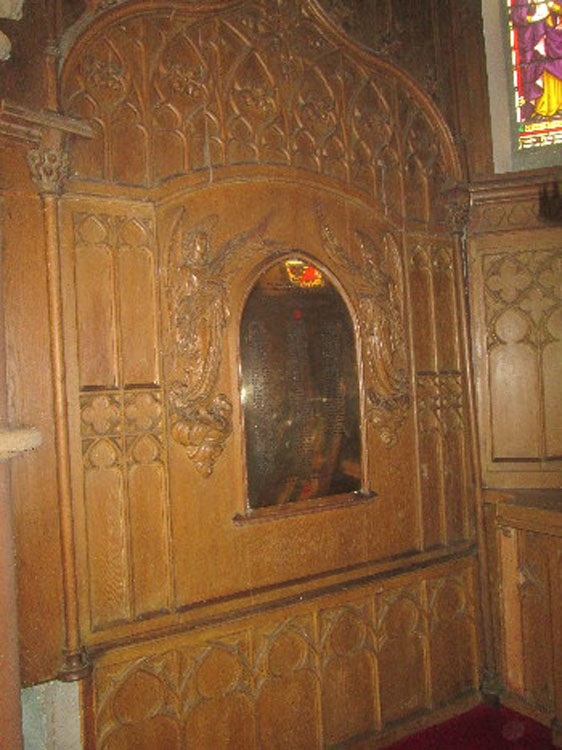
The First World War Memorial in St. Joseph's RC Church, Stanley (Co. Durham)
Photo : James
Pasby
The First World War Memorial in St. Joseph's RC Church, Stanley, Co. Durham, is a side altar with a dedicatory brass plaque built into an oak frame on the left side of the altar. The names commemorated are listed in 3 columns using lower case Roman lettering.
112 names are commemorated as having lost their lives in the First World War. A transcription of the names commemorated is on the Imperial War Museum's Register of War Memorials website.
2 soldiers who served with the Yorkshire Regiment are commemorated on this memorial.
Private Martin O'Neil. 38932.
2nd/8th Battalion Lancashire Fusiliers, formerly 44950 the Yorkshire Regiment.
Killed 21 March 1918.
Born Houghton-le-Spring (Durham), Enlisted Elswick (Northumberland), Resided
Gateshead (Durham).
Commemorated Panel 32 to 34, POZIERES MEMORIAL.
(Note spelling of name "O'Neil")
Lance Corporal Andrew Walsh. 63291. 2nd/1st Battalion
the Yorkshire Regiment.
Son of Michael and Margaret J. Walsh
Died at home 6 October 1919. Age 21.
Buried STANLEY (ST. JOSEPH & SACRED HEART) CEMETERY.
L/Cpl Walsh's death was as a result of a terrible accident in Castlecomer, Ireland. The history of this accident is described below.
 St.
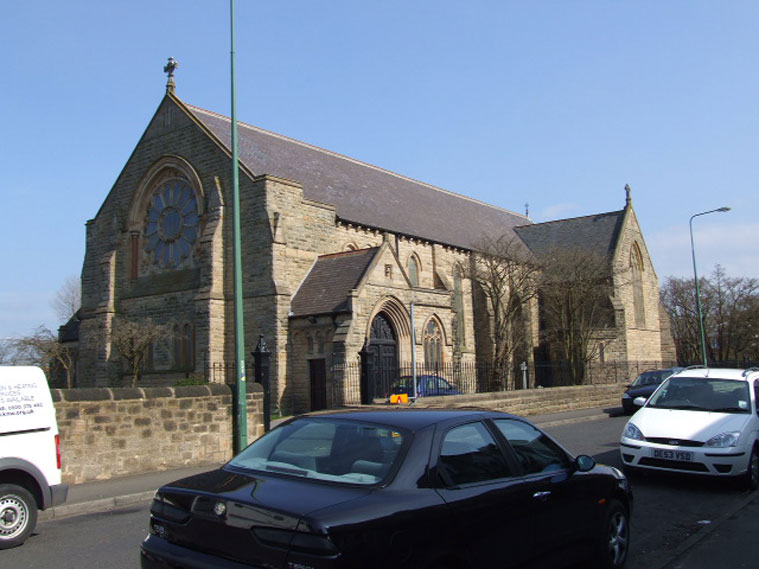
Joseph's RC Church, Stanley (Co. Durham)
St.
Joseph's RC Church, Stanley (Co. Durham)
Photo : © Copyright Peter
Gregson and licensed for reuse under this Creative
Commons Licence.
From "THE 2ND BATTALION IN IRELAND, 1919 to 1921 – SOME HIDDEN CASUALTIES" by Edward Nicholl (published in "The Green Howard", Issue 15, October 2013.
The Castlecomer Coal Mine Explosion
".....there was a highly dramatic episode in which three further soldiers
of the 2nd Battalion Yorkshire Regiment lost their lives.
A contemporary newspaper report found in the website
which lists those who died in the Irish War of Independence reads as follows;-
FATAL EXPLOSION AT CASTLECOMER COLLIERIES
TWO SOLDIERS DIE FROM INJURIES
THREE OTHERS IN PRECARIOUS CONDITION
On Thursday evening last a serious explosion took place at
the Castlecomer Coal Mines, resulting in serious injury to five soldiers belonging
to the Yorkshire Hussars (*). For some time past the men had been doing guard
over a quantity of explosive stored there for use in the mines. Lately the
authorities decided to withdraw the guard and to remove whatever explosives
remained to the Military Barracks in Kilkenny, from where they would be conveyed
to the mines as required under escort. This decision was put into effect on
Thursday evening, and the soldiers were making preparations to leave the place.
Most, if not all, of the “live” explosives had been removed to
a motor lorry some distance away, and there only remained two barrels containing,
it is said, gun powder. This was presumed to be “dead” and therefore
quite harmless and it was intended not to remove it with the rest, but to
destroy it on the spot by digging it into the ground, or in some equally convenient
way.
In the general “cleaning up” of the place, it appears it became
necessary to burn some papers and other waste material, and in some way or
other this came in contact with the barrels, and the contents instead of being
“dead” unfortunately proved to be very much alive. A terrific
explosion occurred, throwing the unfortunate soldiers in all directions.
One of them was, it was stated, hurled through the air a distance of three
hundred yards, and another was dashed against a barbed wire fence and held
fast there. The force of the explosion shook the windows of the Railyard police
barracks about a mile and a half away. The injured soldiers were picked up
by their comrades and taken to the hospital at Castlecomer, and on Friday
night two of them, Corporal Lord and Private Heppenstal, succumbed to their
frightful injuries. One of the other three was more seriously injured than
the two whose injuries proved fatal, and little hope is entertained for his
recovery.
(The seriously injured soldier was Lance Corporal Andrew Walsh who subsequently
died and was buried in Stanley, County Durham.)
* Although the soldiers are referred to in the newspaper report as belonging
to the “Yorkshire Hussars”, the Commonwealth War Graves Commission
records show them as being in the 2nd Battalion the Yorkshire Regiment and
their headstones are marked accordingly. The 19th (Queen Alexandra's Own Royal)
Hussars, - subsequently re-titled the 19th Royal Hussars (Queen Alexandra's
Own) in 1921, was known as the Yorkshire Hussars. Confusingly, their cap badge
is VERY similar to that of the Yorkshire Regiment. And, of course, the “19th”
in the title adds to this confusion.
-----------------> Return to top of the page