 |
War
Memorials Elsewhere, - Royal Society of Chemistry |
|
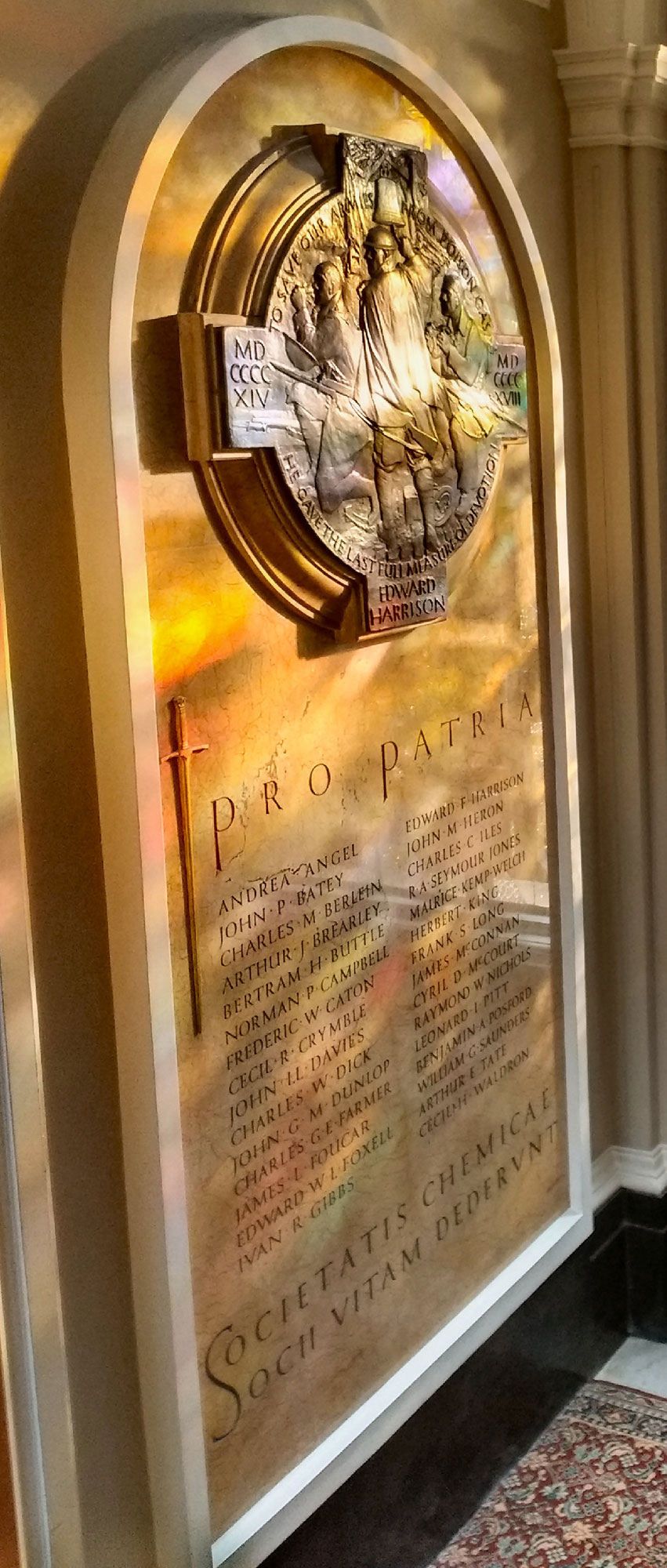
The First World War Memorial for the Chemical Society in the Royal Society
of Chemistry in Burlington House, London
For a larger sized image on which the commemorated names are shown and which
opens in a new window, select the above.
Photo © Copyright Andy
Scott and licensed for reuse under this Creative
Commons Licence.
Two War Memorials are present in the premises of the oyal Society of Chemistry in Burlington House, London.
The First World War Chemical Society Memorial is a memorial to the Fellows of the Chemical Society. The memorial is a bronze roundel on marble tablet. On the roundel British soldiers in a trench are about to adjust their gas masks. Beneath the roundel is a dedication to Edward Harrison (also commemorated on the marble tablet) who had a major role in developing the gas mask for use by British troops.
Of the 30 names commemorated for the First World War, one is that of an Officer who served with the Yorkshire Regiment.
The First World War Institute of Chemistry Memorial is a memorial to the Fellows, Associates and Students of the Institute of Chemistry who had died in the service of their country in the First World War.
Of the 700 Institute members who had served with the H.M. Forces during the war, the losses by death of only 55 were mainly due to the fact that many of those serving were recalled early in the war for chemical service at home. Of the 55 names commemorated, one is that of an Officer who served with the Yorkshire Regiment.
2nd Lieutenant Maurice Kemp-Welch. 10th Battalion Yorkshire
Regiment. Son of James and Olive Kemp-Welch, of "Olantye," Weybridge,
Surrey; husband of Margaret Frazer Kemp-Welch. B.A. (Cambridge). Killed 11
April 1917. Aged 36.
Commemorated on Bay 5, ARRAS MEMORIAL.
The following biographical notes are provided by Robert Coulson in his "Biographies
of Officers of the Yorkshire Regiment";-
"A university man Maurice Kemp-Welch went up to Cambridge entering Kings
College in 1899.
He joined the 10th Battalion during the third week in June 1916 as the battalion
were gearing up for the forthcoming Somme Offensive.
When the great battle opened on July 1st 1916 at 7-30 a.m. 2nd Lt Kemp-Welch
and the battalion attacked just to the north of the village of Fricourt.
Later in the month they were in action at Mametz and the Bazentin Woods.
In August 1916 the battalion were moved to the Arras sector and then back
to the Somme and finally ending 1916 around the town of Loos.
April 1917 saw the opening of the Battle of Arras and 2nd Lt Kemp-Welch and
his men went into action at 6-30 a.m. crossing no-man’s land. The battalion
frontage was from the front line south east of Henin sur Cojeul and after
reaching the German lines 2nd Lt Kemp-Welch and his men were faced with unusually
thick enemy wire, which the artillery had failed to cut. The men were boxed
in against the wire and casualties were high.
2nd Lt Maurice Kemp-Welch was killed in this action on the morning of April
11th 1917 at the age of 36."
The following biographical information is provided in a Royal
Society of Chemistry booklet commemorating those who fought and died in
the First World War;-
"Born in Bristol in 1880, son of James and Olive, Maurice Kemp-Welch
entered King’s College Cambridge in 1899, gaining his BA in business
three years later.On leaving Cambridge, he entered into business, dealing
with the commercial chemistry of oils. Immediately after the outbreak of war
he applied himself to adapting German methods in rubber and with a colleague,
devised a process of coating canvas with rubber. Although his main focus was
primarily commercial, the one characteristic he always displayed was ‘science
for science sake’. He married Margaret Frazer Kemp-Welch in 1911; they
had one daughter, Margaret, in 1912."
Institute of Chemistry Memorial
Captain James Scott Bainbridge. 4th Battalion Yorkshire Regiment.
Killed 22 March 1918.
Commemorated Panel 31 and 32, POZIERES MEMORIALl.
Additional information from Robert Coulson's Biographies
of Officers of the Yorkshire Regiment;-
"James Bainbridge first served as Company Sergeant Major with the 4th
Battalion before receiving his commission and rising rapidly through the ranks.
As an officer he was gassed in June 1917 whilst the battalion were in action
in the Hindenberg Support Line."
The following biographical information is provided in a Royal
Society of Chemistry booklet commemorating those who fought and died in
the First World War;-
"Born in 1888, son of William & Mary Bainbridge, James Bainbridge
later graduated from Leeds University. After university, he went to work in
the chemical laboratory of Messrs Rowntree & Co. in York and was engaged
in the research of the aromatic principle of the cocoa bean.In 1914, he was
appointed research chemist at the Doncaster Coalminers’ Laboratory but
enlisted with the 4th Battalion, Yorkshire Regiment when the war began; in
June 1917, he was caught in a gas attack whilst fighting with his battalion
at the Hindenburg Line.When the German Spring Offensive (Kaiserschlacht or
‘Kaiser’s Battle’) began on 21 March 1918, Captain Bainbridge
and the battalion were moved up to Brie and marched for six hours to the front
line at Hancourt. At 6.30pm on 22 March, as the enemy was pushing the 5th
Battalion Durham Light Infantry (DLI) on the left of the 4th Yorkshires back,
Captain Bainbridge attempted to steady and rally the DLI. He was killed when
he became caught in heavy enemy fire; his body was never recovered."
Further information, including a photo and biographical data, on James Scott
Bainbridge can be found on the Old
Barnardians commemorative website.
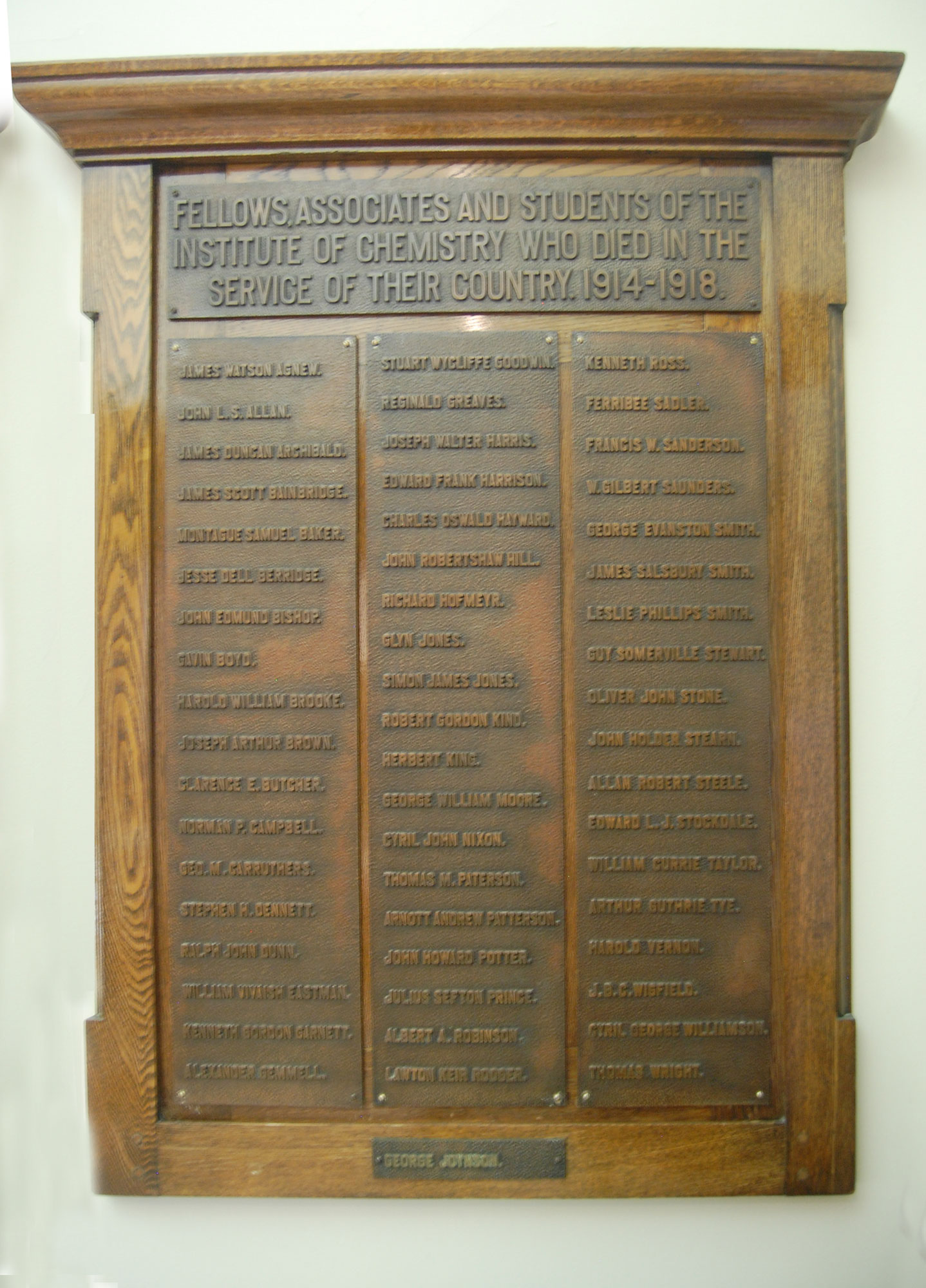
The First World War Memorial for the Institute of Chemistry in the Royal Society
of Chemistry in Burlington House, London
For a larger sized image on which the commemorated names are shown and which
opens in a new window, select the above.
Photo © Copyright Andy
Mabbett and licensed for reuse under this Creative
Commons Licence.
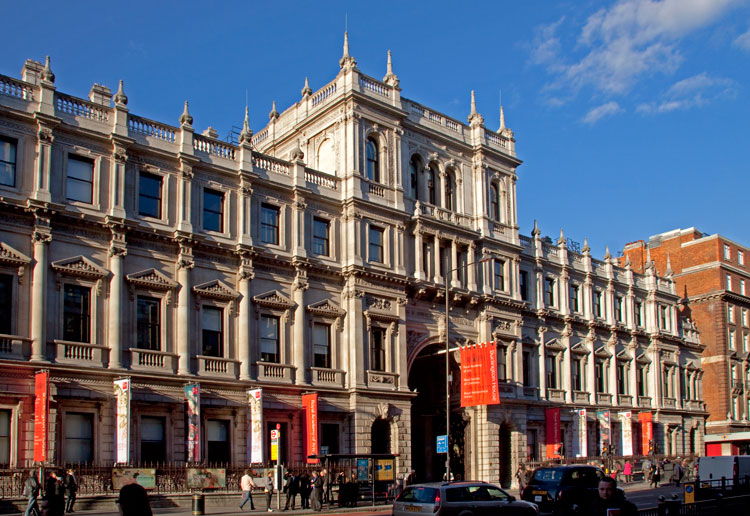 Burlington
House, Picadilly (London) in which the Royal Society of Chemistry is located
Burlington
House, Picadilly (London) in which the Royal Society of Chemistry is located
Photo © Copyright tm
and licensed for reuse under this Creative
Commons Licence.
-----------------> Return to top of the page