 |
War
Memorials Elsewhere, - London University, Roll of War Service |
|
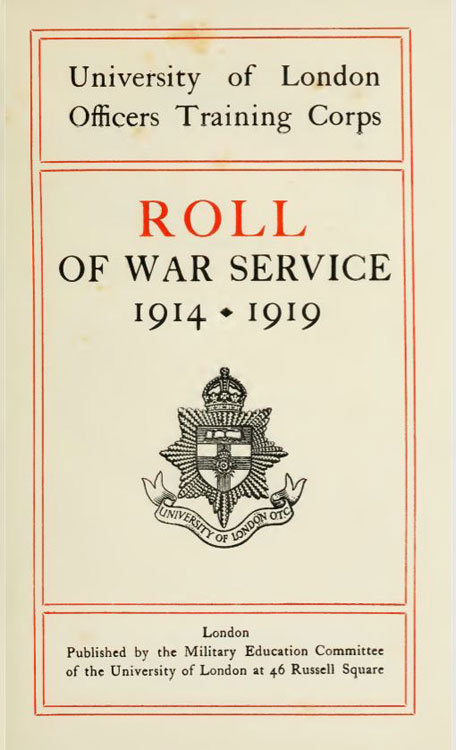
The Title Page of the University of London Roll of War Service
Image London
University Archives
The University of London Roll of War Service has been digitised and can be accessed here.
The names of soldiers who served in the Yorkshire Regiment, and who lost their lives in the First World War, are shown below.
2nd Lieutenant Robert Bernard Abrahams. 4th Battalion Yorkshire
Regiment. Son of Lewis and Millie Abrahams, of 6, Stafford House, Maida Hill,
London. Killed 14 September 1916. Aged 24.
Commemorated on Pier and Face 3A & 3D, THIEPVAL MEMORIAL.
(Lieutenant Abrahams was one of 13 soldiers who served in the Yorkshire Regiment
who are commemorated in the British Jewry Book of Honour. Of the 50,000 Jews
who served with the British and Colonial Forces during the First World War,
2,324 lost their lives and are commemorated in this book.)
The following comments are provided by Robert Couson in his Biographies
of Officers of the Yorkshire Regiment;-
"A solicitor before the war, Robert Abrahams worked for Roberts, Abrahams
and Co in London.
He joined the London University Officer Training Corps in July of 1915 and
was commissioned with the 4th Battalion in September 1915.
Robert Abrahams lost his life during the Battle of the Somme in the summer
of 1916.
In late August and early September the 4th Battalion were involved in training
exercises in the Millencourt area. On September 10th they were called into
brigade support at Shelter Wood and on the evening of September 14th the battalion
moved up into their assembly positions in Eye and Swansea trenches for an
attack the following day.
They had to move up over open ground as the communication trenches were so
crowded. The Germans opened fire on the battalion and caused some forty casualties.
2nd Lt Robert Bernard Abrahams was killed in this action on September 14th
1916 aged 24."
Further details on Robert Bernard Abrahams in the website British
Jews in the First World War.
Lieutenant Henry Ernest Aust. 4th Battalion Yorkshire Regiment.
Son of Thomas and Mary Ann Aust, of "Carn Brea," Northcourt Avenue,
Reading. Killed 18 September 1918. Aged 22.
Commemorated on Panel 5, VIS-EN-ARTOIS MEMORIAL.
The following information on Lieutenant Aust was generously provided by John
Chapman, from information from Reading School.
"Lieutenant Harry Ernest Aust, Yorkshire Regiment, youngest son of Mr
and Mrs Aust of Carn Brea, Northcourt Avenue, Reading, has recently fallen
in action after having seen much fighting on the Western Front. The gallant
officer was with the London University OTC and joined up soon after the outbreak
of war, receiving his commission right away.
It was not so very long after that he was made a full Lieutenant. On one occasion
he was gassed and later was severely wounded in the leg. He was in hospital
eleven months.
Educated at Reading School, Lieutenant Aust subsequently proceeded to London
University where he studied engineering. He was 21 years of age."
The following comments are provided by Robert Couson in his Biographies
of Officers of the Yorkshire Regiment;-
"Henry Aust was born at Reading in Berkshire in 1897.
He attended City & Guilds College and was a member of the London University
Officer Training Corps before the war.
He was wounded in action with the 4th Battalion at Eaucourt L’Abbaye
during the Somme offensive in early October of 1916 and in 1917 the battalion
were involved in the Battles of Arras and later in the year at 3rd Ypres,
Passchendaele.
1918 saw the German Spring Offensive after which much reorganisation and restructuring
took place and on July 16th the 4th Battalion were reduced to a training cadre
when Lt Aust and the remaining officers and men were dispersed to fill the
gaps in other Yorkshire battalions and in some cases to other regiments. Henry
Aust was attached to the 7th Battalion of the East Yorkshire regiment.
Lt Henry Aust was killed in action with the East Yorks at the Battle of Epehy
on September 18th 1918 at the age of 22."
Captain William Liley Batty. 4th Battalion Yorkshire Regiment. Son
of Tom and Sarah Batty, of "North View", Drighlington, Bradford,
Yorks. Killed 25 October 1916. Aged 24.
Commemorated on Pier and Face 3 A and 3 D, THIEPVAL MEMORIAL.
The following comments are provided by Robert Couson in his Biographies
of Officers of the Yorkshire Regiment;-
"Captain Batty served on the Somme with the 4th Battalion moving into
the battle area in September of 1916.
He was wounded in the battalion’s action at Eaucourt L’Abbye in
early October but refused to let this hold him back. On the night of 24/25th
October with the battalion ordered up to the line to provide a relief Captain
Batty though still suffering with his wounds remained at duty and moved up
with his men. He was killed in this action at the age of 24."
2nd Lieutenant George Edwin Chapman. 5th Battalion the Yorkshire
Regiment. Son of Ebenezer and Clara Emma Chapman, of The Cottage, Ivy Lane,
Woking, Surrey. Gold and Silver Medallist (Chemistry) University College,
London; Goldsmid and Ellen Watson Scholar, University College; Mathematical
Scholar, University of London. Killed 27 September 1916. Aged 20.
Buried GROVE TOWN CEMETERY, MEAULTE.
The following comments are provided by Robert Couson in his Biographies
of Officers of the Yorkshire Regiment;-
"A mathematical scholar at the University of London before the war George
Chapman arrived on the Somme battlefield in late August of 1916 to join with
the 5th Battalion.
The battalion took part in an attack between High Wood and Martinpuich close
to Morval on September 15th during which George Chapman was wounded and taken
from the battlefield for treatment.
2nd Lt George Edwin Chapman died from his wounds on September 27th 1916 at
the age of 20."
2nd Lieutenant Walter Harold Game. 5th Battalion Yorkshire Regiment.
Son of Ellen Game and the late George A. J. Game, of 16, Culmstock Rd., Clapham
Common, London. Killed 23 April 1917. Aged 21.
Commemorated on Bay 5, ARRAS MEMORIAL.
The following comments are provided by Robert Couson in his Biographies
of Officers of the Yorkshire Regiment;-
"Walter Game was born in Battersea in London in 1896 and attended London
University where he was a member of the University Officer Training Corps.
Serving with the 5th Battalion he was wounded in action on September 15th
1916 during the Battle of the Somme in an attack between High Wood and Martinpuich.
The battalion remained on the Somme until late January 1917 when several moves
followed and by early April they were in Corps reserve near Arras.
On April 23rd the 2nd Battle of the Scarpe began and at 4-45 a.m. 2nd Lt Game
and his men advanced in support of the 4th East Yorkshires. A German counter
attack was launched and Walter Game was killed as the battalion faced up to
meet the enemy."
Lieutenant Herbert Charles Hale. 4th Battalion the Yorkshire Regiment.
Son of Mr. and Mrs. Hale, of 26, Cadogan Terrace, Victoria Park, London. His
brother Sidney Walter Hale also fell. Killed 2 November 1917. Aged 27.
Buried DOZINGHEM MILITARY CEMETERY.
The following comments are provided by Robert Couson in his Biographies
of Officers of the Yorkshire Regiment;-
"Herbert Hale attended the Sir John Cass Technical Institute and was
an active member of the University of London Officer Training Corps before
the war.
After being gassed in June of 1916 he was invalided home and returned to France
in April of 1917.
He was wounded in action on October 29th 1917 serving with the 4th Battalion.
They were fighting in what was described as a “swamp” between
Houlthurst Forest and the village of Passchendaele towards the end of the
3rd Battle of Ypres.
Removed to a casualty clearing station for treatment Lt Herbert Hale lost
his fight for life on November 2nd 1917 at the age of 27. He is buried close
to where he would have been treated in Dozinghem Military Cemetery on the
east side of the Poperinghe to Krombeke road."
Lieutenant Henry Leslie Harrison. Royal Air Force, formerly 4th
Battalion the Yorkshire Regiment. Son of Henry George and Emma Jane Harrison,
of 38, Richmond Rd., Barnsbury, London. Died at home 28 October 1918. Aged
23.
Buried HIGHGATE CEMETERY.
The following comments are provided by Robert Couson in his Biographies
of Officers of the Yorkshire Regiment;-
"Henry Harrison was a member of the University of London Officer Training
Corps before the onset of war.
He served with the 4th Battalion in France and Flanders and was twice wounded
in action with the battalion.
The first was during the Somme offensive in actions at Eaucourt L’abbaye
in late September early October 1916.
He recovered to rejoin the battalion and during the great German Spring Offensive
of March 1918 was wounded again in operations around the town of Hancourt.
Shortly after this the 4th Battalion was disbanded and Lt Harrison was transferred
to the newly formed Royal Air Force.
He died of pneumonia in Reading just before war’s end on October 28th
1918 at the age of 23.
His grave today lies unmarked in Highgate Cemetery in London where his name
is remembered on Panel 2 of the screen wall."
2nd Lieutenant Walter James Hayton. 4th Battalion Yorkshire Regiment.
Son of Mrs. E. J. Hayton, of "Falconhurst", Windsor Rd., Linthorpe,
Middlesbrough, and the late James Hayton. Died 16 September 1916. Aged 23.
Commemorated Pier and Face 3 A and 3 D, THIEPVAL MEMORIAL.
The following comments are provided by Robert Couson in his Biographies
of Officers of the Yorkshire Regiment;-
"Walter Hayton was a Middlesbrough man born in the town in 1893 and as
a young man attended London University where he was also a member of the Officer
Training Corps.
He was serving with the 4th Battalion when they moved into the Somme offensive
of summer 1916.
In late August and early September 2nd Lt Hayton was training with the battalion
at Millencourt. On September 10th they moved up to Shelter Wood in brigade
reserve and on September 14th assembled in Eye and Swansea trenches for an
attack between High Wood and Martinpuich.
September 16th saw the battalion attack at 9-25 a.m. bombing their way eastward
along the German position of Prue trench.
2nd Lt Walter James Hayton was killed in this action on September 16th 1916
aged 23 and was acting as battalion casualty officer at the time."
Lieutenant Henry Francis Heatly. 2nd Battalion the Yorkshire Regiment.
Son of Henry Louis and Kate S. Heatly, of 29, Carleton Rd., Tufnell Park,
London. Killed 22 February 1915. Aged 24.
Buried CABARET ROUGE CEMETERY.
The following comments are provided by Robert Couson in his Biographies
of Officers of the Yorkshire Regiment;-
"Henry Heatly was born in Islington on August 30th 1890.
He was educated at University College School followed by London University
where he was an active member of the Officer Training Corps and keen marksman,
winning many competitions with his shooting prowess.
After gaining his B Sc degree he was commissioned into the Yorkshire regiment
in April of 1913.
At the onset of war in August 1914 he was serving with the 3rd Battalion on
coastal defence work around Hartlepool and the Tees Bay.
In October 1914 Henry Heatly travelled to France with the 2nd Battalion of
the East Lancashire Regiment to whom he had been attached.
The following year while inspecting a new trench with a fellow officer, 2nd
Lt Henry Francis Heatly was killed by a German sniper dying on Monday February
22nd 1915 aged 24."
See also his entry in "Bond of Sacrifice
2nd Lieutenant Robert Ernest Murray Hofmeyr. 5th Battalion Yorkshire
Regiment, attached 63rd Coy Machine Gun Corps. Killed 24 April 1917.
Commemorated on Bay 5, ARRAS MEMORIAL.
The following comments are provided by Robert Couson in his Biographies
of Officers of the Yorkshire Regiment;-
"A South African by birth, Robert Hofmeyr was studying dentistry at the
Middlesex and Royal Dental Hospital and was a member of the London University
Officer Training Corps.
Robert Hofmeyr died during the 1917 Battle of Arras.
Serving with the 5th Battalion, on April 20th, they moved up from just outside
Arras to a position known as Nepal Trench. Three days later the battalion
were used to halt a German attack and when two battalions came up to strengthen
the line all three battalions attacked the German positions together.
2nd Lt Robert Ernest Murray Hofmeyr was killed in this action on April 24th
1917 while attached to the Machine Gun Corps."
2nd Lieutenant Harry Needham Laing. 4th Battalion Yorkshire Regiment.
Son of Henry George Needham Laing and Sarah Laing, of The Lindens, Grove Park,
Denmark Hill, London. A member of the London University O.T.C. Killed 17 September
1916. Aged 20.
Commemorated on Pier and Face 3A & 3D, THIEPVAL MEMORIAL
The following comments are provided by Robert Couson in his Biographies
of Officers of the Yorkshire Regiment;-
"Harry Laing was a student at the London School of Economics and also
a member of the Officer Training Corps of London University.
He was gazetted as a 2nd Lt and joined the 4th Battalion in January of 1916
in the Ypres Salient. He took part in the “Operations at the Bluff”
and also saw action around Kemmel in the early part of 1916.
August and September of that year found the battalion in training at Millencourt
and on September 10th they moved into the Somme battle being in Brigade reserve
at Shelter Wood. On September 14th 2nd Lt Laing and his men assembled in Eye
and Swansea trenches in preparation for the Battle of Flers-Courcelette.
2nd Lt Harry Needham Laing was killed in action in the area of Prue Trench
and Martin Alley on September 17th 1916 aged just 20.
Lieutenant Herbert Sarif Roy Montesole. Royal Sussex Regiment, attached
to the 2nd Battalion the Yorkshire Regiment.
Son of Max and Emma Montesole, of Hornsey, London. B.Sc. (London), A.M.I.C.E.
Killed 17 May 1915.
Buried GUARDS CEMETERY, WINDY CORNER, CUINCHY
Lieutenant Montesole’s father, Max, wrote the following biography of
his son in July 1916;-
H S Roy Montesole. B.Sc (London) A M I C E
Lieutenant 2nd Royal Sussex Regiment
Born at 270 Wightman Road, Hornsey. Educated at the Stationers’ and
London County Secondary Schools. Entered London University (King’s College
Engineering Section) and graduated B.Sc in June 1914. Joined the London University
AT C (in which he rose to be a Sergeant) in 1911 and was gazetted to the Special
Reserve of the Royal Sussex Regiment in July 1914.
Took out a draft of the 2nd Yorkshire Battalion from West Hartlepool to France
on October 12 1914 (* Not correct, - the date was after October 1914) and
served with distinction in that battalion in the trenches between Armentieres
and Festubert during the terrible winter of 1914-1915.
Took part in the Battle of Neuve Chapelle (being one of the officers who survived
that action), the Battle of Fromelles, May 9 1915, and fell on the second
day of the Battle of Festubert, being at the moment of his death the only
combatant surviving officer of those who had served throughout the winter.
“One of the best subalterns in the Regiment” wrote Major Stansfeld,
on whom devolved command of the battalion, “Always cheerful, perfectly
cool, daring and resourceful.”
On the battlefield of Neuve Chapelle, on Feb 13 1915, he met his two brothers
Eric and Alan (See Note 4) whom he had not seen since July 1914. They were
then serving in the 7th Middlesex Regt. Eric, who later became 2nd Lieutenant
and Machine Gun Officer in the 7th Royal Sussex Regt was killed at the Hohenzollern
Redoubt on March 3 1916. Alan is now a subaltern in the Machine Gun Corps.
His eldest brother – Herschel – is a Captain in the R A M C attached
to the 2nd Royal Fusiliers which has just suffered so terribly at the Battle
of the Somme.
Another brother, Max, is serving in the Canadian Army. .
2nd Lieutenant Cyril John Perkins. 4th Battalion Yorkshire Regiment.
Husband of Norah G. Perkins, of 39, Mantilla Rd., Upper Tooting, London. Killed
27 June 1917. Aged 23.
Buried ACHIET-LE-GRAND COMMUNAL CEMETERY EXTENSION.
The following comments are provided by Robert Couson in his Biographies
of Officers of the Yorkshire Regiment;-
"Cyril Perkins was born in Battersea, London in 1895 and was a member
of the University of London Officer Training Corps after attending Battersea
Polytechnic.
After the 1917 Battle of Arras 2nd Lt Perkins and the 4th battalion had “Twelve
days pleasantly spent at Famechon”.
The respite was short lived however and by June 16th the battalion were back
in the line in the Hindenburg Support where for six days they incurred casualties
from shell and rifle fire and predominantly gas.
2nd Lt Cyril John Perkins was wounded during this period and died from his
wounds on June 27th 1917 at the age of 23."
2nd Lieutenant James Leslie Roberton. 25th Squadron Royal Flying
Corps, formerly 4th Battalion Yorkshire Regiment. Son of R. H. and Mary L.
Roberton, of Stoke Golding Lodge, Nuneaton, Leicestershire. Killed 6 September
1916. Aged 21.
Commemorated on the ARRAS FLYING SERVICES MEMORIAL.
The following comments are provided by Robert Couson in his Biographies
of Officers of the Yorkshire Regiment;-
"James Roberton was born at Stoke Golding Lodge in Nuneaton on September
7th 1894.
He was educated at Magdalen College School in Oxford and in the spring of
1913 travelled to South Africa to study farming.
Deciding agriculture was not for him he returned to England in 1914 and enrolled
at London University as a medical student where he was also a member of the
Officer Training Corps.
James Roberton was commissioned into the Yorkshire Regiment on August 12th
1915 and for a time was machine gun instructor with the 4th Battalion before
transferring to the Royal Flying Corps in April of 1916 and gaining his pilots
certificate on August 11th 1916.
Patrolling the lines between Hulloch and Lens in September he was attacked
by a Fokker, crashing to the ground where his petrol tank exploded.
2nd Lt James Leslie Roberton was killed in this incident on September 6th
1916 aged just 21.
James Roberton was the youngest son of Robert Hopkins Roberton JP and his
wife Mary Louisa of Stoke Golding Lodge."
Captain Douglas Spurway. 4th Battalion the Yorkshire Regiment. Son
of Dr. John Spurway and Mrs. Spurway, of 74, Brondesbury Rd., Kilburn, London.
Killed 23 March 1918. Aged 22.
Commemorated on Panels 31 & 32, POZIERES MEMORIAL.
The following comments are provided by Robert Couson in his Biographies
of Officers of the Yorkshire Regiment;-
"Douglas Spurway, a doctor’s son was born at Tring in Hertfordshire
in 1895 and was a medical student at St Bartholomews Hospital and also a member
of the Officer Training Corps of London University before hostilities.
Serving with the 4th Battalion he first went to France in July of 1916 and
when the German Spring Offensive opened in March 1918 Captain Spurway and
the battalion were in training at Ignaucourt and were rushed up to the line
at Hancourt.
On March 23rd the battalion were ordered to retire to a line running from
Vraignes to Bouvincourt. The battalion fought a rearguard action all the way
back until they reached the high ground near to Le Mesnil-Bruntel. Here Captain
Spurway and his men were ordered to hold the German advance while the other
battalions got over the Somme river.
Captain Douglas Spurway was killed in this action on March 23rd 1918 aged
22."
Lieutenant Frank Brenand Whitehead. 5th Battalion Yorkshire Regiment.
Killed 23 April 1917. Aged 19.
Commemorated on Bay 5, ARRAS MEMORIAL.
The following biographical details are provided in the Kingston
Grammar School archives;-
Frank Brennand Whitehead was born on the 1st September 1897, son of Captain
Frank Preston Whitehead, master mariner, and his wife Mary.
Frank’s admission record shows that his father captained a South African
liner. His mother was a British subject but born in Mossel Bay, South Africa.
Frank Whitehead was baptised at St. Luke’s, Kingston on 14 January 1898.
He attended Kingston Grammar School from 1907- 1908, before moving to a private
preparatory school in Surbiton, Surrey. He then followed his elder brother
Edwin to Tonbridge School in Kent.
Frank Brenand Whitehead was at Tonbridge
School from 1912 - 1915. In the biographical details of F B Whitehead
provided on the Tonbridge School website it is said that he entered Tonbridge
School from Elm House School, Surbiton.
The following biographical details are provided in Robert Coulson's Biographies
of Officers Killed in the First World War;-
"Frank Whitehead attended London University where he was a member of
the Officer Training Corps.
He joined with the 5th Battalion in the summer of 1916 on the Somme and saw
action in September in attacks between High Wood and Martinpuich.
Lt Whitehead was wounded in action in November of 1916 at Mametz Wood and
was invalided home to recuperate. He rejoined the battalion in March 1917
at Bayonvillers and in early April they moved into corps reserve close to
Arras.
On April 23rd the battalion were brought forward to Nepal Trench at 4.45 a.m.
and used to meet a developing German counter attack.
Lt Frank Brennand Whitehead was killed in this action during the Battle of
Arras on April 23rd 1917.
Lt Whitehead was the son of Mr and Mrs F Whitehead of Southgate in north London."
Captain Noel Tracey Wright. 3rd Battalion Yorkshire Regiment, attached
to 2nd Battalion. Son of Tobias T. and Emma S. Wright. Born at Bombay, India.
Killed 1 October 1915. Aged 21.
Buried SAILLY-LABOURSE COMMUNAL CEMETERY.
The following biographical notes are provided by Robert Coulson in his Biographies
of Officers of the Yorkshire Regiment;-
"Noel Wright was born in Bombay in India in 1894 where his father worked
for the railway company.
He attended University College in London and at the onset of war was commissioned
into the Yorkshire Regiment on August 15th 1914.
He was attached to the 2nd Battalion on December 15th 1914 joining them in
the Ypres Salient.
He was promoted to Lieutenant in February of 1915 and the following month
saw action at the Battle of Neuve Chapelle. He fought again in May at Festubert
and in June at Givenchy after which he was promoted again to Captain.
In September when the Battle of Loos opened the battalion were at Vermelles
and from here on September 25th Captain Wright in charge of “B”
company advanced towards Hulloch and Cite St Elie. Fighting went on for the
next few days and on the night of September 30th the Yorkshires were ordered
up to reinforce a battalion of the Royal Fusiliers. At 9-30 p.m. Captain Wright
and his men went forward only to find just one gap in the wire where they
could pass through.
On detecting their movement the Germans immediately put up Very Lights and
concentrated heavy fire on this part of the wire, severely wounding Captain
Wright.
Taken from the battlefield for treatment, Captain Noel Tracey Wright died
of his wounds the next day October 1st 1915 aged 21."
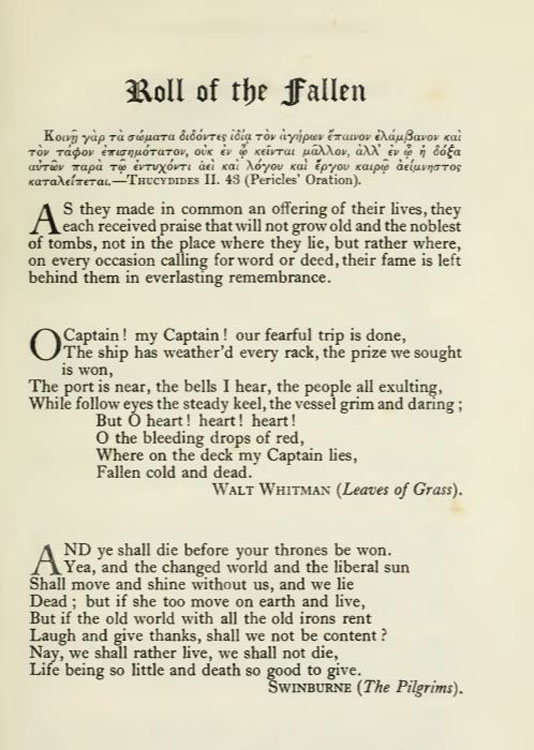
The Rollof the Fallen
Image London
University Archives
-----------------> Return to top of the page