 |
War Memorials, - Elsewhere Durham School |
|
The Durham School Logo
Durham School is an English independent boarding and day school in Durham City. Although the school was founded in 1414, in 1844 the school moved from its site on Palace Green to its current location across the river Wear. The school is often referred to in histories and the Oxford Dictionary of National Biography as "Durham Grammar School". It should not be confused with the Chorister School, Durham.
Durham School was an all-boys institution until 1985, when girls were admitted to the sixth form.
In the First World War 97 Old Boys of the school lost their
lives, and 79 lost their lives in the Second World War.
The names of these men are commemorated in the School Chapel, as described
in the Imperial War Museum's Register
of War Memorials website, together with a transcription of the names.
However there is also a book entitled “The War Record of Old Dunelmians 1914-1919”. This contains a list of names, years at the school; rank; regiment; honours; whether wounded or killed and other information. The book has been transcribed by the North East War Memorials Project.
Of those commemorated, 2 were Officers who served with the Yorkshire Regiment.
Lieutenant Colonel Bertram Lionel Maddison. 2nd Battalion the Yorkshire
Regiment, attached 8th Battalion York & Lancs Regt. Killed 1 July 1916.
Buried BLIGHTY VALLEY CEMETERY, AUTHILLE WOOD.
Biographical information on Lieutenant Colonel Maddison
is shown below.
Lieutenant Thomas Tweddell. 3rd Battalion Yorkshire Regiment, attached
7th Battalion East Yorks Regiment. Son of Henry Arthur and Edith Mary Tweddell,
of "Greenhow," Belle Vue, West Hartlepool. Killed 28 June 1918.
Aged 23.
Buried ST. SEVER CEMETERY, ROUEN.
Biographical information on Lieutenant Tweddell is
shown below.
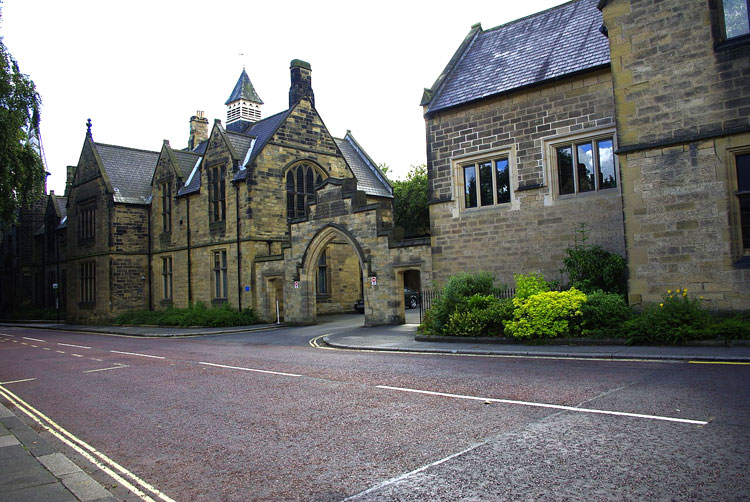 The
front of Durham School taken from the road outside, illustrating the Kerr
Arch in the centre.
The
front of Durham School taken from the road outside, illustrating the Kerr
Arch in the centre.
Photo : © Copyright Teach46
and licensed for reuse under this Creative
Commons Licence.
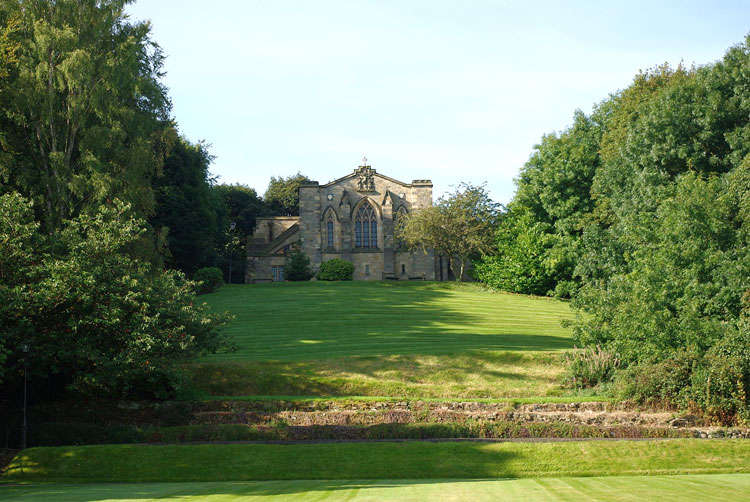 The
Durham School Chapel from the main school buildings
The
Durham School Chapel from the main school buildings
Photo : © Copyright Teach46
and licensed for reuse under this Creative
Commons Licence.
Lieutenant Colonel Bertram Lionel Maddison.
The following comments are from Robert Coulso's Biographies
of Officers of the Yorkshire Rgiment;-
"Bertram Maddison was born in Durham on July 12th 1881.
A serving officer before the war he was first commissioned in 1901 and saw
service in the Boer War.
He joined the 2nd Battalion in France in February of 1915 and on March 11th
was wounded in action at Neuve Chapelle. On recovery he was posted to the
8th York and Lancasters as second in command and was again wounded in action
in January 1916.
On his return to duty with the battalion he was appointed commanding officer
on May 12th 1916.
When the Somme offensive opened on July 1st 1916 the battalion attacked the
village of Ovillers. They cleared the enemy first line and entered the second
but here due to heavy losses the attack faltered and a withdrawal was ordered.
Lt Col Bertram Lionel Maddison was killed in this action on July 1st 1916
aged 35.
Lt Col Maddison was the son of Thomas Maddison of South Bailey, Durham.
After his death the Green Howards Gazette wrote,
“No officer of the regiment who has given his life in this war is more
worthy of our honour and respect. Few of us have had the welfare of the regiment
more at heart than he and to none was its honour more precious. To those who
served under him and to the friends who loved him, his cheerfulness and gentle
unselfishness, handicapped as he was by increasing deafness remain an enduring
example”.
The following information is recorded in the “The War Record of
Old Dunelmians 1914-1919”;-
"Lieutenant-Colonel BERTRAM LIONEL MADDISON.Yorkshire Regiment,
was the third son of T. Maddison, Esq., South
Bailey, Durham, and entered the School as a Day Boy in May l894. He left in
December 1897, and joined the East Surrey Militia from which he was gazetted
to the 1st Yorkshire Regiment in 1901. He served in the South African War
from 1900 to 1902, taking part in operations in the Transvaal, and receiving
the Queen's medal with four clasps.
He was promoted Lieutenant in 1904, Captain in 1910, and Major in l915.
After serving in Egypt and the Soudan he came home for a turn of duty at his
Regimental Depot, and on the outbreak of the war was attached to the 3rd Yorkshire
Regiment. He was present at the bombardment of Hartlepool, joined the 2nd
Battalion in France in January 1915, and was wounded at Neuve Chapelle.
In August he was appointed Second in Command of the 8th Battalion York and
Lancaster Regiment, and was
wounded a second time in January 1916, whilst serving in Asia Minor.
He subsequently commanded the Battalion in France, and was killed in the Battle
of the Somme on the 1st July 1916."
Lieutenant Thomas Tweddell.
The following comments are from Robert Coulso's Biographies
of Officers of the Yorkshire Rgiment;-
"Thomas Tweddell was born on March 31st 1895 in West Hartlepool, County
Durham.
He received his commission on December 23rd 1914 and joined the 2nd Battalion
on June 18th 1915 at Les Harisoirs.
2nd Lt Tweddell was wounded in action at the Battle of Loos in September of
1915 and after hospitalisation rejoined the 2nd Battalion at Bray in February
of 1916.
He received his promotion to Lieutenant but then in March of 1916 was wounded
again resulting in him being invalided home.
Lt Tweddell was attached to the 7th East Yorkshires on his recovery from his
wounds in the spring of 1918.
In early June the battalion were involved in an attack on the village of Beaumont
Hamel on the old Somme battlefield and during this action Lt Tweddell was
severely wounded and hospitalised again.
Lt Thomas Tweddell died of his wounds on June 28th 1918 at the age of 23.
He was the son of Henry Arthur and Edith Mary Tweddell of “Greenhow”
Belle Vue in West Hartlepool where his name is remembered on the town’s
war memorial."
The following information is recorded in the “The War Record of
Old Dunelmians 1914-1919”;-
Lieutenant THOMAS TWEDDELL. 3rd Yorkshire Regiment, was the son of
H.A. Tweddell, Esq., Jesmond,
West Hartlepool, and was born in 1895.
He entered the School House in September 1910, and left in July 1911. He then
matriculated at London
University, and was studying Engineering there when the war broke out; he
passed his first examination for B.Sc. in September 1914, and worked as a
volunteer for the A.S.C. until December in the Motor Transport branch.
He received his commission in the 3rd Yorkshire Regiment on the 23rd December
1914, and joined his Regiment in France
in May 19l5, where he suffered from trench fever and rheumatic fever.
His ankle was badly fractured whilst he was leading his men into action on
the 8th June 1918, and he died in hospital at Rouen on the 28th June of that
year from blood poisoning which set in after amputation.
-----------------> Return to top of the page