 |
War Memorials, - Elsewhere Brighton College |
|
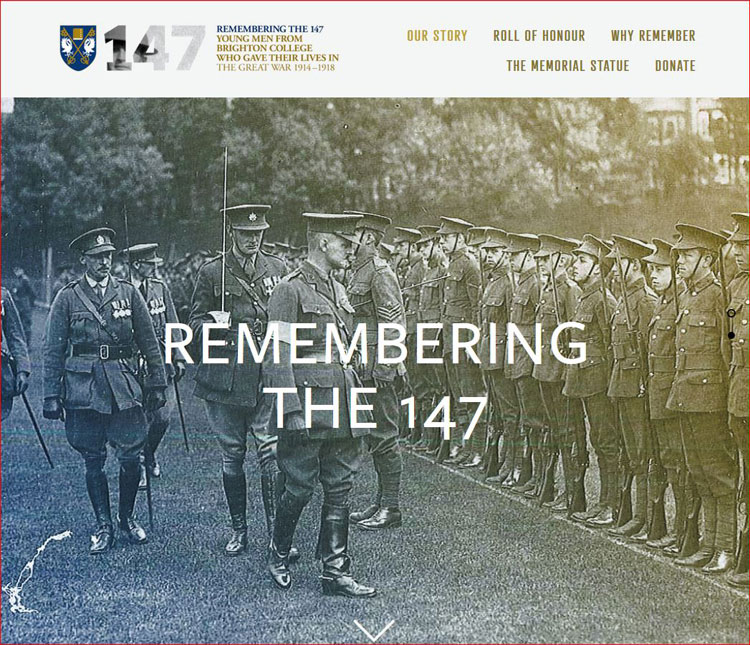 The
Brighton College Memorial Website for Old Boys Who Lost Their Lives in the
First World War
The
Brighton College Memorial Website for Old Boys Who Lost Their Lives in the
First World War
Brighton College was founded in 1845 and was the first Victorian public school to be founded in Sussex.
The school has set up a website to commemorate the 147 Old Boys who lost their lives in the First World War. The data in this website is principally based on a Roll of Honour compiled by the school in 1920. To date (December 2015) only 78 of the 147 Old Boys are commemorated. Biographical details and, in some cases portrait photos, are presented.
2 of the Brighton College Old Boys served with the Yorkshire Regiment.
Lieutenant Colonel Charles Arthur Cecil King.
2nd Battalion Yorkshire Regiment. Son of James and R. Maria King; husband
of Adela Margaret King, of 33, Evelyn Gardens, South Kensington, London. Served
in the Sudan, Burmese, and the South African Campaigns (Brevet Maj). Twice
Mentioned in Despatches.
Killed 30 October 1914. Aged 51.
Commemorated Panel 33, YPRES (MENIN GATE) MEMORIAL.
Born at Capetown, 6th February. 1863, son of James and R. Maria King; husband
of Adela Margaret King, of 33, Evelyn Gardens, South Kensington, London.
Lieut., 9th September, 1882 ; Capt., 15th February 1893; Adjt 3rd Battn. (Militia),
20th November, 1896—19th May, 1902; Brevet Major, 22nd August, 1902
; Major, 18th February, 1905 ; Lieut -Col. 29th September, 1910 ; Col., 16th
December, 1913.
Served in the Nile Expedition, 1885. and with the Soudan Frontier Force, 1885-6,
including the action at Ginnis (medal and Khedive's star). Served with a column
in Burmah in 1892 (medal and clasp for Katchin Hills). Took part in the Boer
War, 1900-02. as Adjt., 3rd Battn.( Queen's medal and two clasps. King's medal
and two clasps, twice mentioned in despatches, and Brevet. of Major).
Awarded the King's Coronation medal, 1911. Commanded the 2nd Battn. in the
Expeditionary Force in Belgium and France (twice mentioned in despatches).
Killed at Ypres, 25th October, 1914. Memorial tablet in Richmond Parish Church,
Yorkshire.
"This bald statement of his distinguished services would show that in
him the Army has lost a valuable and experienced soldier, but it in no way
conveys the sense of a personal bereavement which is felt by those of all
ranks who had the privilege of serving with him. The cheeriest, kindliest
and most generous of friends, he was beloved both by his brother officers
and by the men who served under him, taking a keen interest in all sports,
he encouraged and shared in all their amusements. How many a dull hour did
he brighten for his comrades. How many a dreary station became the happier
and livelier for his presence! No kinder or more genial host could be found;
his hospitality was proverbial, and he was never happier than when entertaining
his friends. Of the thrilling story of those last few eventful days before
his death, we at present know but little, but we do know that it is a story
of brave deeds and cheerful devotion to duty, a story that will live long
in the annals of our Army, telling of a heroic struggle against well-nigh
overwhelming odds. In this struggle he played a splendid part" (G.H.G.).
2nd Lieutenant George Clarence Knowles. 9th Battalion
the Yorkshire Regiment. Son of Mr. Knowles, of "Kirkwood," The Villas,
Palmer's Green, London. Killed 10 June 1917.
Buried LIJSSENTHOEK MILITARY CEMETERY.
Robert
Coulson provided the following information in his Biographies of Yorkshire
Regiment Officers;-
"George Knowles was born in London on July 31st 1897. He was gazetted
as a 2nd Lieutenant on August 16th 1916 and joined the 9th Battalion in October
of 1916 during the Somme offensive, seeing action at the Le Transloy Ridges.
In late October of that year the battalion were moved north and spent Christmas
and the New Year of 1917 in and out of the line in the Ypres Salient.
In preparation for the Messines battle the battalion moved up into position
in the assembly trenches during the evening of June 6th 1917. The attack went
in at 6.5 0a.m. the following morning and 2nd Lieut Knowles was wounded in
this advance and
taken from the battlefield for treatment. He died of his wounds three days
later on June 10th 1917 at the age of 20."
A brother officer wrote later,
“We have lost our very dearest and best beloved boy in the battalion.
He was idolised by his men. In difficult times in the trenches and when in
rest he was always doing something for the care of his platoon and his boldness
and absolute disregard
of danger when in action was superb. The greatest thing he could have done
he did gloriously and his faithfulness in simple matters was part of his life”.
-----------------> Return to top of the page