 |
North
Yorkshire
War Memorials, - Middlesbrough, - Riverside Stadium |
|
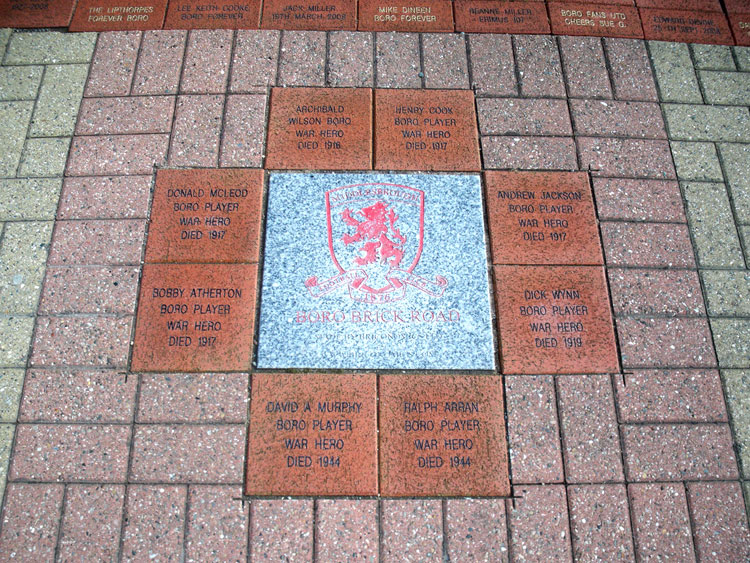 The
War Memorial in the "Brick Road" Outside the Old Ayresome Park Entrance
at Middlesbrough's Riverside Stadium
The
War Memorial in the "Brick Road" Outside the Old Ayresome Park Entrance
at Middlesbrough's Riverside Stadium
Photo :
Bolckow
The Boro Brick Road was first launched in 2005 and comprises around 10,000 bricks. Recently refurbished, the Boro Brick Road is sited next to the gates from the old Ayresome Park stadium. These gates are a major feature of the Riverside Stadium.
Amongst the bricks in the Boro Brick Road is the set, photograph above, commemorating men who have played for the Middlesbrough Football Club but who lost their lives in the two World Wars.
8 men are commemorated, of whom 2 were soldiers who served with the Yorkshire Regiment.
We are very grateful to Bolckow for his photos (posted on Flickr) of this memorial.
Serjeant Henry Cook. 20982. 12th Battalion Yorkshire
Regiment. Son of Alice Ann Cook, of Middlesbrough. Died 9 January 1917. Aged
23.
Born Middlesbrough, Enlisted Middlesbrough.
Buried GROVE TOWN CEMETERY, MEAULTE.
(CWGC has "Serjeant H Cook", but SDGW = "Private H Cook")
The following entry is found for Henry Cook in Wikipedia;-
"Henry Cook (1893 – 9 January 1917), sometimes known as Harry Cook,
was an English professional footballer who played as a wing half in the Football
League for Middlesbrough. He also played for South Bank and appeared as a
guest for Brentford during the First World War.
Prior to becoming a professional footballer, Cook was a teacher at Marton
Road School and North Ormesby Junior Boys' School in Middlesbrough and had
a wife and two children. During the First Word War he served as a sergeant
in the 12th (Service) Battalion of the Yorkshire Regiment, known as the Teeside
Pioneers. He was wounded in early January 1917 while the battalion was engaged
in road works in the vicinity of Maurepas, Somme. He died of his wounds on
9 January 1917 and is buried in Grove Town Cemetery, Méaulte. At the
time of his death, Cook had been accepted for a commission and would have
returned to England three days later to begin officer training.
Serjeant Richard Cross Wynn. 20955. 12th Battalion
Yorkshire Regiment, transferred to Labour Corps (CSM 340210, 17th Coy). Son
of Samuel and Elizabeth Wynn; husband of Maud Mary Wynn, of 24, Pease St.,
Eastbourne, Darlington. Native of Walton, Liverpool. Died 9 August 1919. Aged
27.
Buried ETAPLES CEMETERY.
(Shown as "Dick Wynn" on the memorial).
The following biography of Richard Cross Wynn is provided in
the Everton FC Heritage Society WWI and WW2 Remembrance Booklet;-
"Born in 1892, and living in the shadow of Goodison Park, by his late
teens Richard Wynn was working in a local rubber works while playing centre-forward
for Sterling FC in Liverpool & District League 1910-11 season.
He signed amateur forms for Everton for the 1911-12 season and played as an
outside-left, and although he was retained for a further year, by June 1912
he was loaned to Chester, where he joined his brother Robert in the same team.
Officially released by Everton in April 1913, he was quickly rated as the
best half-back in the Lancashire Combination, and was snapped up by Middlesbrough
in April 1914, scoring on his debut against Spurs.
By the summer of 1915 he had volunteered for the 12th Battalion Yorkshire
Regiment (Teesside Pioneers), while brother obert enlisted with the Grenadier
Guards.
Robert later secured a transfer to the 12th Yorks on 11 May 1915 to be with
his brother. After a year in training they landed in France in June 1916.
During his periods of leave Richard had time to make 22 guest appearances
for Brentford scoring eight goals. While Robert was discharged home on 23
Feb 1919, Richard, now a sergeant, was transferred to the 17th Company Labour
Corps and remained in France during post-war clear up work. Although he survived
the conflict and was due to return to Middlesbrough for the 1919-20 season
he died on 9 August 1919 aged twenty-seven from injuries suffered in an accident
while still serving in France. He was laid to rest in Etaples Military Cemetery."
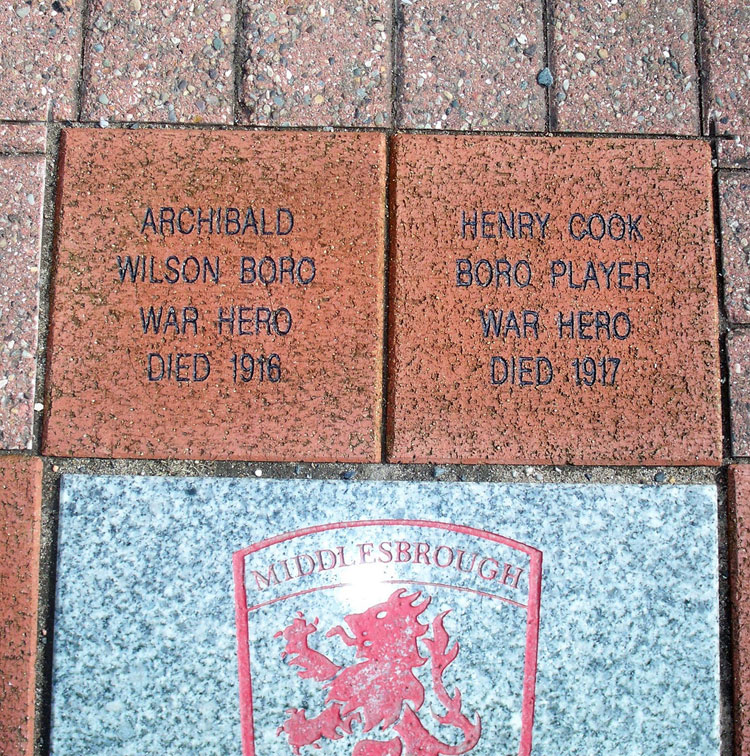 The
War Memorial in the "Brick Road" Outside the the Old Ayresome Park
Entrance at Middlesbrough's Riverside Stadium (Henry Cook's Name)
The
War Memorial in the "Brick Road" Outside the the Old Ayresome Park
Entrance at Middlesbrough's Riverside Stadium (Henry Cook's Name)
Photo :
Bolckow
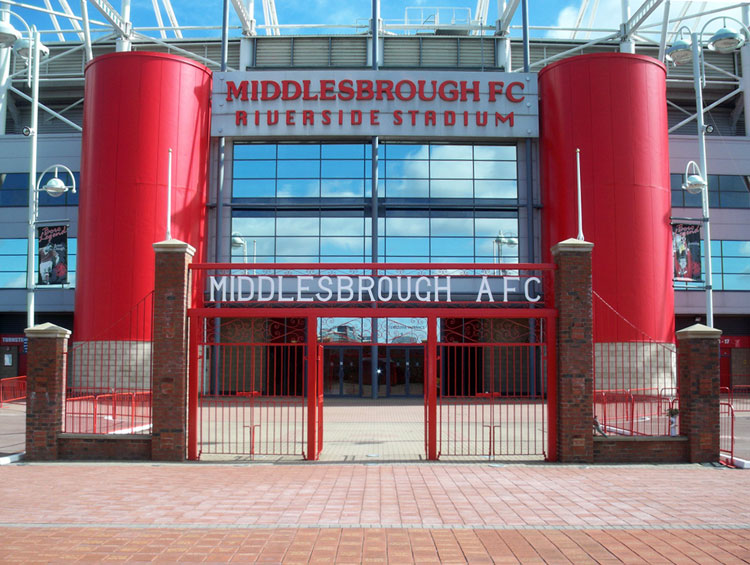 The
Gates from the old Ayresome Park stadium, Outside the Riverside Stadium
The
Gates from the old Ayresome Park stadium, Outside the Riverside Stadium
-----------------> Return to top of the page