 |
War
Memorials, - Elsewhere Hollybrook Memorial |
|
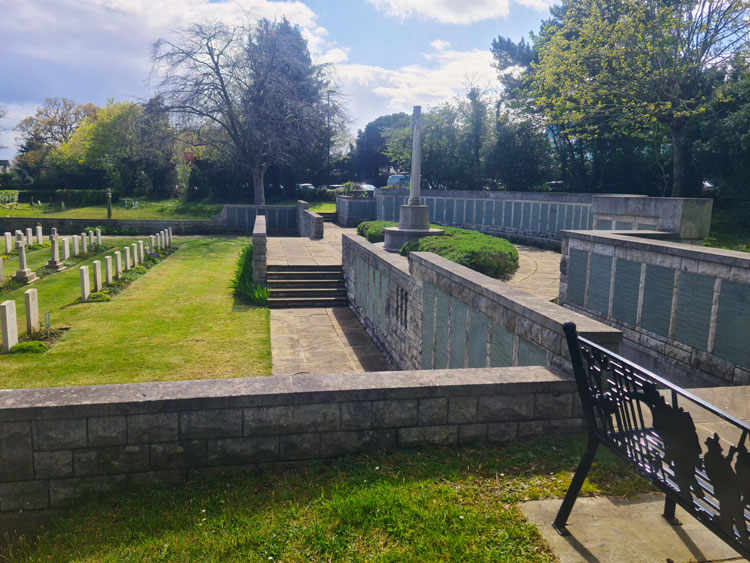 The Hollybrook Memorial, Southampton
Photo : Wayne Bywater (<waynetyke123@aol.com>)
Southampton was No 1 Port during the First World War and military hospitals were established in the University buildings, in the Highfield Institution and at Shirley Warren. During the Second World War, 4.5 million tons of military equipment passed through Southampton docks and parts of the prefabricated harbours used at Arromanches during the Normandy invasion were made there. For a while, Southampton was also base to the 14th Major Port Transportation Corps of the United States Army.
Southampton (Hollybrook) Cemetery contains burials of both wars and a memorial to the missing.
The cemetery has a First World War plot near the main entrance containing
most of the 125 graves from this period. Behind this plot is the Hollybrook
Memorial which commemorates by name almost 1,900 servicemen and women of the
Commonwealth land and air forces whose graves are not known, many of whom
were lost in transports or other vessels torpedoed or mined in home waters.
It also bears the names of those who were lost or buried at sea, or who died
at home but whose bodies could not be recovered for burial.
(See the photo, below, for the location of the First World War Graves Plot
and the Hollybrook Memorial.)
There are 10 names for men who served with the Yorkshire Regiment, including 3 who went down with the Hospital Ship "Anglia" on 17 November 1915.
Private Christopher William Bell, 13724. 10th Battalion
the Yorkshire Regiment. Killed 17 November 1915. Aged 29.
Born West Hartlepool (Christchurch), Enlisted West Hartlepool , Resided 2
Commercial Terrace West Hartlepool.
(Amongst those who died when Hospital Ship "Anglia" was sunk by
a mine off Dover on 17 November 1915).
Captain Cecil Aubrey Bradford. Yorkshire Regiment, attached to the Nigeria
Regiment W A F F. Second son of the late Lt.-Col. O. J. Bradford, of Welparke,
Lustleigh, S. Devon, and Mrs. Mary Ann Ellen Bradford; husband of Mildred
Ellen Grace Wyatt-Edgell (formerly Bradford), of Tettenhall Wood, Wolverhampton.
Served in the Cameroons. Died 24 April 1917. Aged 31.
(Captain Bradford was lost at sea when travelling home on S.S. Abbosso, which
was torpedoed by a German submarine.)
Private William Bycroft. 14379. 8th Battalion Yorkshire
Regiment.Son of Fred and Harriet Bycroft, of 3, Wellington St., Middlesbrough.
Died 17 November 1915. Aged 20.
Born Middlesbrough, Enlisted Middlesbrough.
(Amongst those who died when Hospital Ship "Anglia" was sunk by
a mine off Dover on 17 November 1915).
Private Edward George Daynes. 32540. 1st Battalion
Yorkshire Regiment. Killed 16 January 1917.
Born Horstead (Norfolk), Enlisted Thirsk, Resided Sowerby (Thirsk).
(The 1st Battalion the Yorkshire Regiment were stationed in India throughout
the First World War. Research by Steve
Billings has shown that Private Daynes died on his way out to India on
the HMT Sierra Leone. The cause of death was cerebro spinal meningitis.)
Lance Serjeant Arthur Duke. 21637. 1st Battalion the
Yorkshire Regiment.
Shown in "The Great War Heroes of Bridlington" has having been drowned
at sea, returning from India, on 2 June 1919. Aged 20.
Commemorated on Panel 104 (addenda), HOLLYBROOK MEMORIAL.
However, from the 1901 Census, he was born in 1889. Also his death certificate
shows him as being aged 29 at the time of death.
His age at death is also stated as being 29 in the Commonwealth War Graves
Commission data.
Private Walter Nicholson, 17072. 1st Garrison Battalion
the Yorkshire Regiment. Died 10 December 1916.
Born Halifax, Enlisted Middlesbrough, Resided Boosbeck.
(May possibly have died on the same transport as Private Daynes)
Private William Norris, 42572. 2nd Battalion the Yorkshire
Regiment, formerly 1435 East Yorks Regt. Died 3 August 1918.
Born Hull, Enlisted Hull.
Private William Proctor, 8995. 1st Garrison Battalion
the Yorkshire Regiment. Died at sea 16 January 1918.
Born Merthyr Tydfil (Glam), Enlisted Chester, Resided Leeds.
Private James Gibson Scott. 56240.
Depot The King's (Liverpool Regiment), formerly 14264 the Yorkshire Regiment.
Son of the late Robert and Anna Scott. Killed 23 May 1918. Aged 30.
Born South Shields (Durham), Enlisted South Shields, Resided South Shields.
(Some details as to the circumstances of Private Scott's
death are shown below)
Lance Corporal William Edward Twist,8688. 10th Battalion
Yorkshire Regiment. Son of Mrs. Mary Twist; husband of Edith Marion Morland
(formerly Twist), of 12, Victoria Rd., Thornaby-on-Tees, Co. Durham. Killed
on 17 November 1915. Aged 32.
Born Bishop Auckland, Enlisted Thornaby-on-Tees.
(Amongst those who died when Hospital Ship "Anglia" was sunk by
a mine off Dover on 17 November 1915).
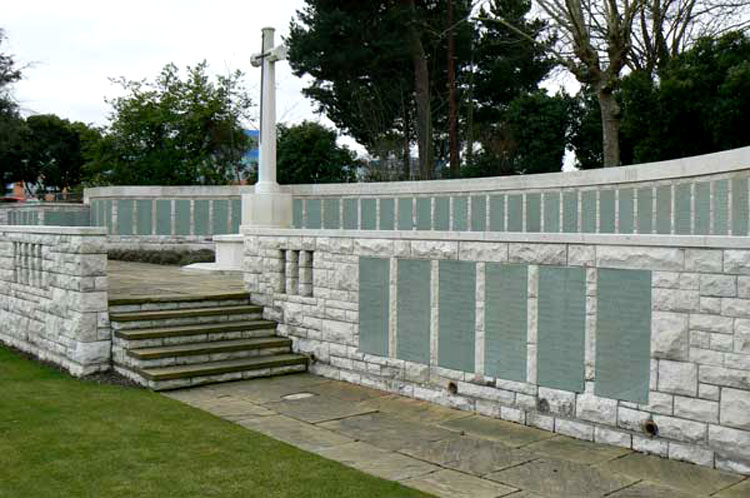 The Hollybrook Memorial, Southampton
(Photograph kindly provided by John Cronin (<john.j.cronin@ntlworld.com>).)
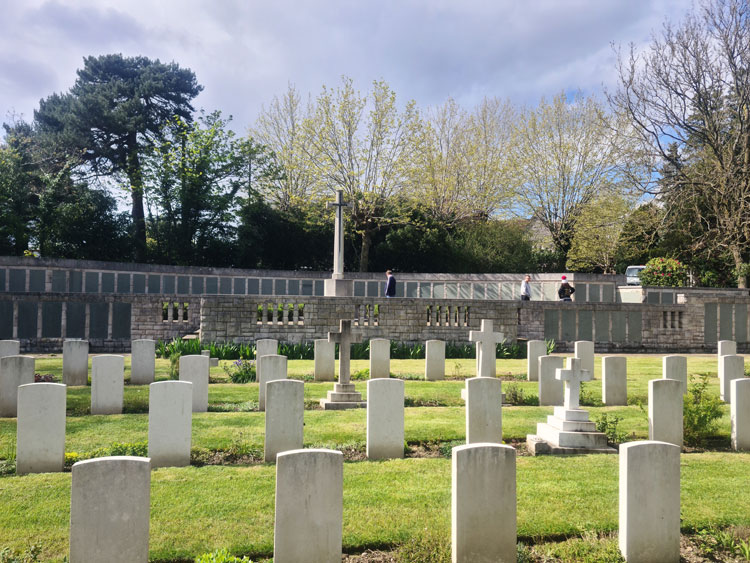 The
Hollybrook Memorial, Southampton
The
Hollybrook Memorial, Southampton
Photo : Wayne Bywater (<waynetyke123@aol.com>)
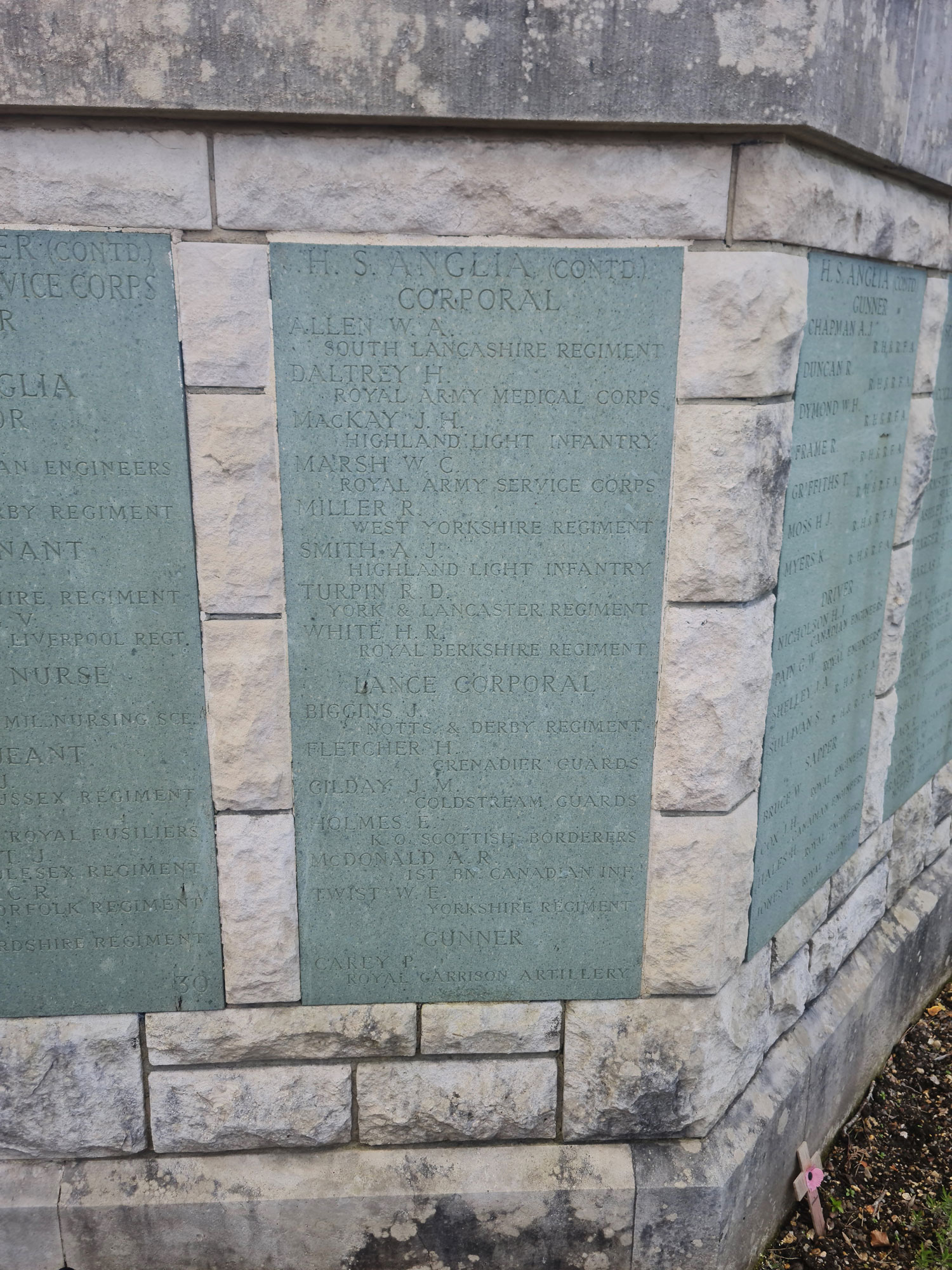
The Name of L/Cpl Twist on the Hollybrook War Memorial
Select the above image for a larger sized image which opens in a new window
Photo : Wayne Bywater (<waynetyke123@aol.com>)
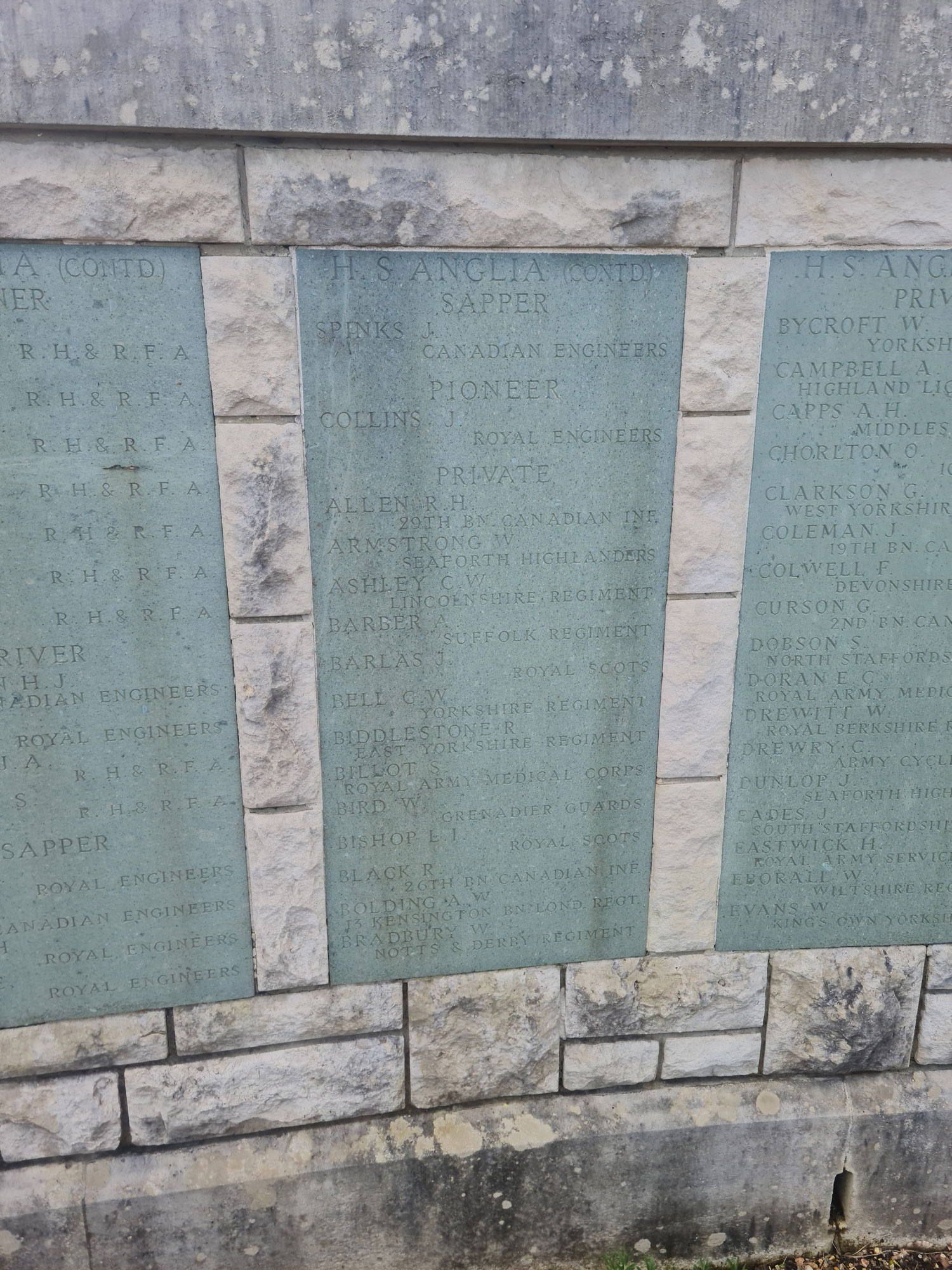
The Name of Private Bell on the Hollybrook War Memorial
Select the above image for a larger sized image which opens in a new window
Photo : Wayne Bywater (<waynetyke123@aol.com>)
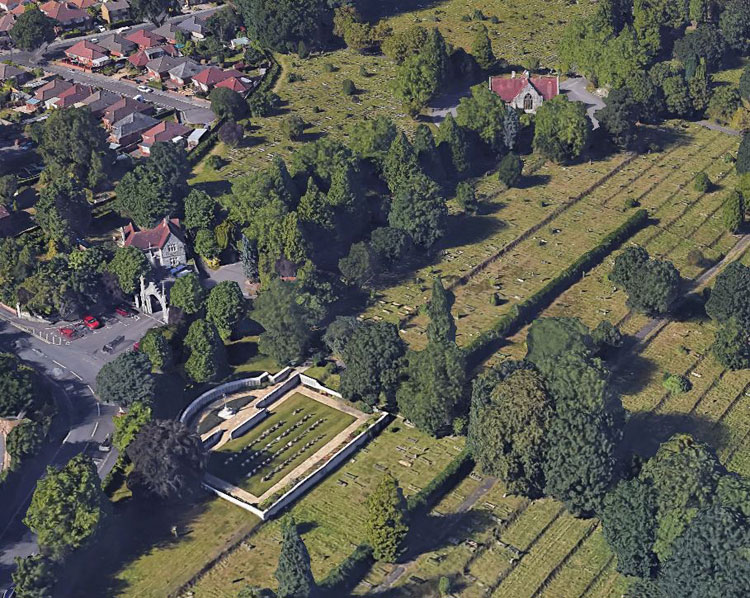 Southampton
(Hollybrook) Cemetery,
Southampton
(Hollybrook) Cemetery,
Showing the First World War Burial plot, Behind Which is the Hollybrook Memorial.
Photo : Google
Earth
-----------------> Return to top of the page
The Circumstances of Private Scott's Death
Pte J G Scott was lost at sea on the SS Innisfallen 23/5/1918
“Innisfallen,” built at Newcastle for the city of Cork Steam Packet Company Ltd., by Messrs. Wigham Richardson, Ltd., length 272 feet, breath 35.5 feet, depth 16.9 feet.
Sunk by German submarine at 10.30 am on Thursday, 23rd May 1918, between the Skerries and the Kish lightship, just as the Irish land was sighted. She was on a voyage from Liverpool to Cork with general cargo, under the command of Captain Albert Cole.
Mr. Wilkinson, second officer, was on the bridge, when the look out man called his attention to a torpedo coming in the direction of the ship. He instantly ordered the helm hard to port, jumped across the bridge to help the man at the wheel to do so, but only succeeded in getting it over a few spokes when the torpedo struck the ship right abreast of the boilers and engine room. The impact was terrible, and the scene which followed was appalling, the boilers burst, scattered death and destruction around, and many were killed outright by falling debris.
Captain Cole at once gave orders to lower the lifeboats, but as the “Innisfallen” was rapidly sinking (she went down in a few minutes) it was only possible to launch one of them, her occupants being;- Captain Cole, J. B Mullins, 1st officer; J. Wilkinson, 2nd officer; and W. J. Collister, 1st engineer.
The lifeboat was also doomed to destruction, as the rigging of the sinking steamer fouled her, capsized and smashed it, leaving them struggling. Fortunately they saw another of the lifeboats which floated off the “Inisfallen” as she went down, and they succeeded in getting into her.
Mr. Robert King, the 3rd Engineer, gives the following thrilling account of the disaster: “When the explosion occurred I was asleep in one of the state rooms, and was completely knocked out of my bunk, being thrown onto the floor. I then saw that the floor of the room has been burst up and the room all wrecked. I crawled out on my hands and knees, and when got on deck saw a raft. The “Innisfallen” was at this time nearly submerged, the afterdeck being awash. After some time I reached the raft, on which I found the chief steward, a sailor and a gunner, and Just as I climbed on to it I saw the “Innisfallen” go under.”
Another survivor, J. C. Twomey, A. B. States:- “Several of us managed to get hold of lifebelts, but I could not get mine on before the boilers exploded. Some of the boats were smashed and eleven of us succeeded in getting into a boat which afterwards capsized, and we were all flung into the water. I then grasped the keel of an upturned boat and got astride it, and after some time I saw other survivors in another boat and hailed then, and soon afterwards they hauled me aboard.
“While I was clinging to the capsized boat, the submarine came to the surface quite close. She was a very large one, camouflaged all over with different coloured stripes, and about thirty of her crew were on deck, who in the most callous manner were looking on, jeering and laughing, until smoke was seem on the horizon, when she suddenly submerged and made off”.
This proves to be H.M. destroyer “Kestrel,” which arrived on the scene shortly after “Innisfallen" went down and ultimately rescued twenty-four survivors from the rafts and boats. The destroyer dropped several depth charges to destroy the submarine, but whether they were successful or not is not known. The destroyer searched around on the scene of the calamity in the hope of finding other survivors, but nothing was seen except floating wreckage. She then proceeded to Dublin and landed the survivors at the North wall. The 2nd Officer and a Fireman were detained in Hospital in Dublin owing to injuries received.
Eleven were lost, viz.:-L.F. Raybould, 2nd officer, 3rd Engineer; S. Creevy, J. Keown greasers; D. Cronin, gunner; one passenger (a soldier); F. Gallagher, cattlemen; and five coloured firemen.
The saved were:- Captain Albert Cole, J.B. Millins, 1st officer; S.Wilkinson 2nd officer; W.T. Collister, 1st engineer; R. King, 2nd engineer; Jas. Ryan, donkey man, J. Tate, carpenter; H. Morgan, quartermaster; Jas. Fuger, quartermaster; A. Finch, A.B.; Thomas Donoghue, A.B.; J.C. Twomey, A.B.; Patrick Donovan, A.B.; Thomas Connor, A.B.; J. Todd, Michael Walsh, steward; W.H. Brophy, H. Stewart, gunners; D.J. Butler, cattlemen and five coloured firemen. Total –24.
Description taken from the following source,
http://olivecolemanfamilyhistory.tripod.com/port.html
and forwarded by Richard Roberts (richard.nsw@googlemail.com<>).
-----------------> Return to top of the
page