 |
North
Yorkshire
War Memorials, - Guisborough |
|
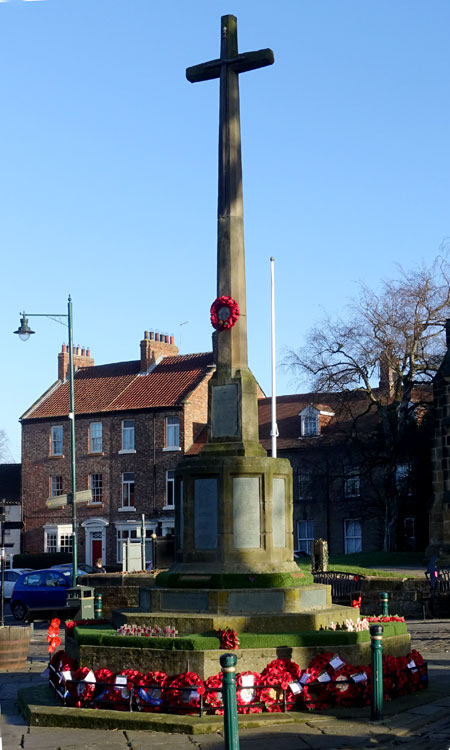
The Guisborough War Memorial in front of St. Nicholas' Church
Photo : Edward Nicholl
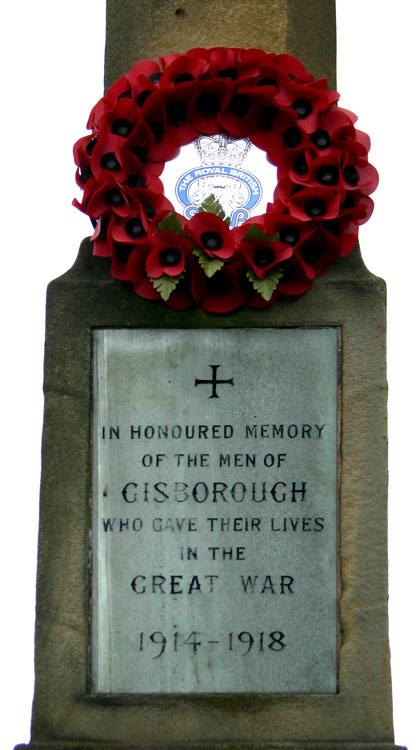
The Dedication on Guisborough's War Memorial
Photo : Edward Nicholl
An account of the design, commissioning, and unveiling
of the Guisborough War Memorial has been written by Bill Clarke (<bclarke096@hotmail.co.uk>),
who has also authored a book on the Guisborough, Upleatham and Dunsdale War
Memorials,
- "Guisborough Remembers the Great War". To read about
the design, commissioning and unveiling of the memorial,
select the link in this paragraph.
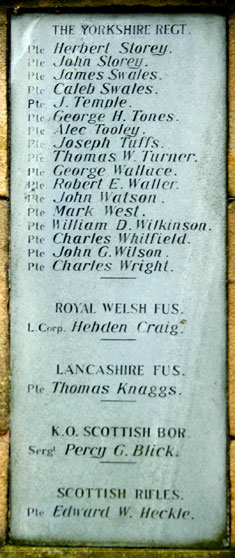
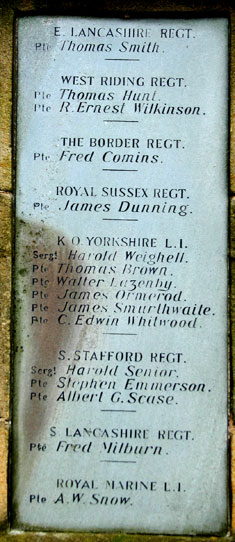
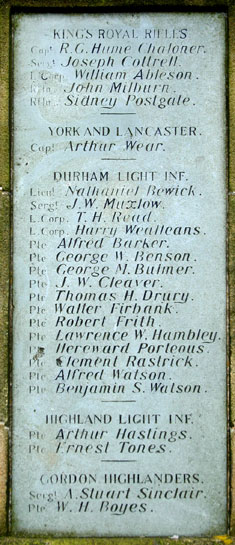
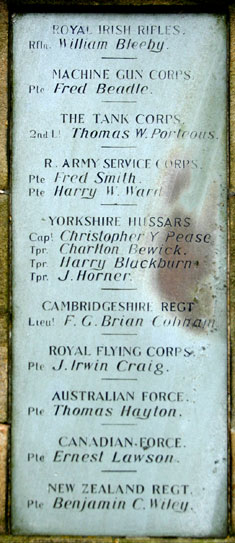
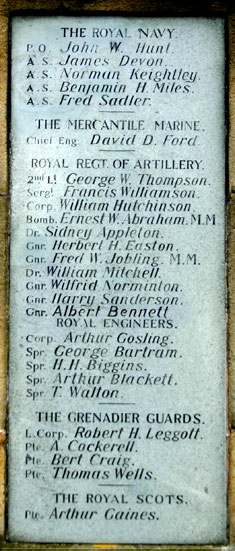
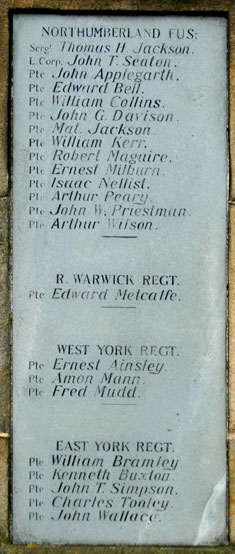
The Guisborough Memorial Cross has an octagonal base on which is placed the eight plaques recording the names of those who lost their lives in the First World War. All of these plaques are shown below. Three of the plaques contain the names of the men of the Yorkshire Regiment, and details of these names can be found by selecting the link, below.
(*) There is at least one "typo" amongst the names below. "Pte George H Tones" of the Yorkshire Regiment is, in fact, "George Herbert JONES" of the Yorkshire Regiment.
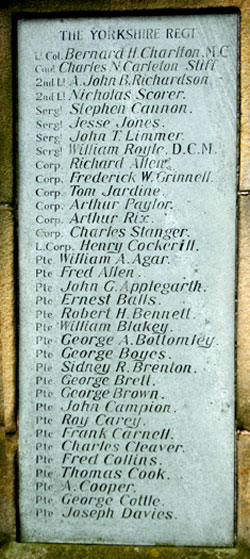 |
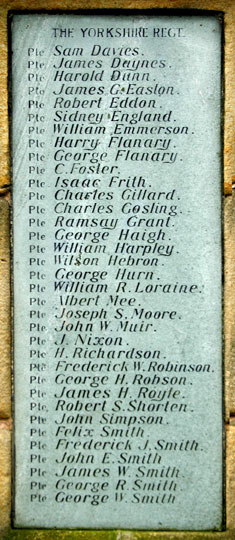 |
 |
-----------------> Return to top of the page
The five other panels that are on the Guisborough War memorial are as below;-
 |
 |
 |
 |
 |
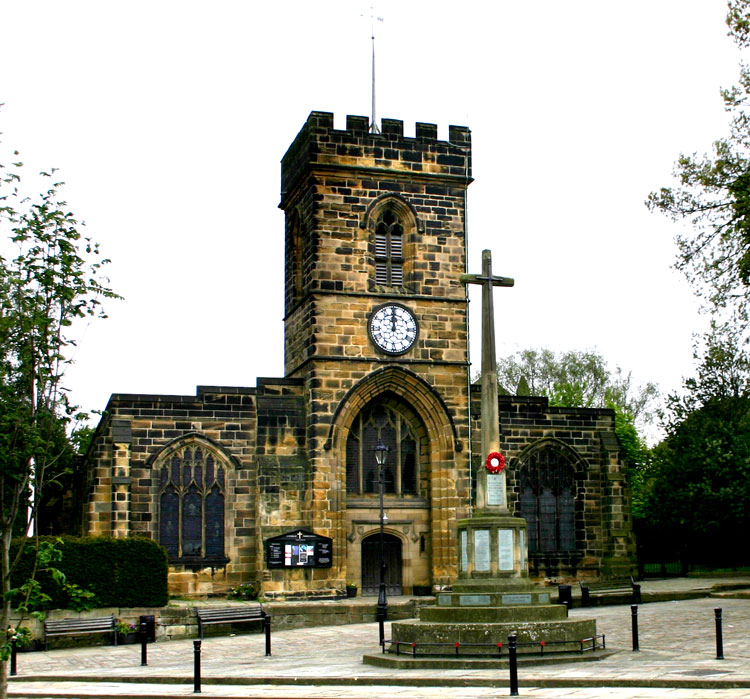 The War Memorial in front of St. Nicholas' Church, Guisborough.
(Photo : Edward Nicholl)
THE GUISBOROUGH WAR MEMORIAL
by Bill Clarke (<bclarke096@hotmail.co.uk>)
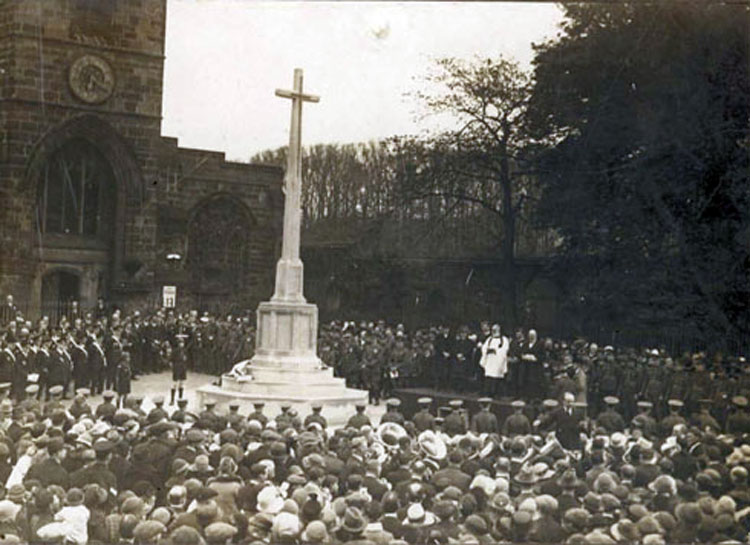 The
Unveiling of the Guisborough War Memorial, 20 May 1925 (1)
The
Unveiling of the Guisborough War Memorial, 20 May 1925 (1)
DESIGN
The war memorial is based on an octagonal block with a Cross of Sacrifice
built on it. It has a downward pointed bronze sword attached to the front.
The cross is there to show the religion of most of the dead which was Christianity.
The sword shows that the memorial is to do with war. Another name used could
be that of a cenotaph which is defined as a monument honouring a dead person
or persons buried elsewhere.
HISTORY
The impetus for the creation of war memorials was primarily local. There was
no government funding or directives, but national committees were created
to advise on the design of memorials. For example, in 1919 the Victoria and
Albert Museum held a war memorial exhibition and published a pamphlet of suggested
inscriptions.
Originally there were 196 names on the war memorial, but in 2001 the name of gunner Albert Bennett, Royal Regiment of Artillery was added. There are now 197 names of members of the Armed Forces who made the supreme sacrifice which in those days would have represented three per cent of the town’s population.
The decision was taken at a public meeting held on 15 February 1919 and was
presided over by the Chairman of the Council, Councillor E. Wilson. An appeal
for subscriptions was made in the town and the public responded generously.
Then came a setback. The depression of the early 1920s had a severe effect
on the town and the project was put on hold. It was nearly four years before
it was revived.
The War Memorial Committee that had been set up called a public meeting in
November 1924, – chaired by Tom Pallister, and the project was again
set in motion.
The public subscriptions had amounted to £380 towards the target of £700, and a collection at the close of the meeting produced a further £70. The target was quickly reached and the decision was made to erect the memorial in front of the parish church.
On 8 May 1925, the War Memorial Committee wrote to the Council requesting them to “care for and preserve the war memorial and to officially accept it on the day of the unveiling”.
It was also agreed that a sum of ten shillings be paid to Lord Gisborough in exchange for the grant of land to be kept in trust for ever, to be used as a site for the war memorial.
On Wednesday evening, 20 May 1925, the war memorial was unveiled. A large
crowd assembled, with relatives of the men whose names were engraved on the
memorial, allocated a special stand.
The Priory Band was present, as were the clergy from the different churches
in the town.
After the singing of “Oh God Our Help” the unveiling was performed
by Colonel B G Price, C.B., C.M.G., D.S.O. who had commanded the Yorkshire
and Durham Brigade of the 50th Division. After he had drawn the Union Flag
from the memorial, he delivered a stirring speech of praise, sympathy and
encouragement.
The Rector of Guisborough, the Rev. O G Mackie, dedicated the memorial and after the Dead March had been rendered by the band, the War Memorial Committee Chairman officially handed over the memorial to councillor G W Trigg Chairman of The Council.
The last post was sounded by trumpeters of the 8th Hussars, followed by a minute’s silence. The Reveille was sounded, and then the National Anthem sung to close the ceremony.
Since then other significant events that have taken place have been as follows.
25 April 1984 listed as a Grade Two building.
November 2001 there was a wreath rail constructed and donated by the Ironmongers Company of London.
Various names have been added and spellings of names corrected.
ACKNOWLEDGEMENTS.
Special thank you to the following who have allowed information to be used in this research of the Guisborough, Dunsdale and Upleatham War Memorials.
Stewart Clarke Local Historian
Andy Warren c/o www.militaryimages.net
Edward Nicholl c/o www.ww1-yorkshires.org.uk
Commonwealth War Graves Commission
Ancestry.co.uk
War Memorials Trust
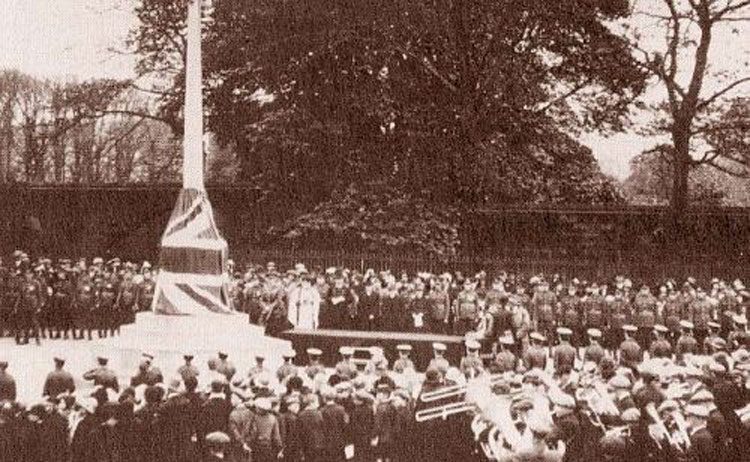 The
Unveiling of the Guisborough War Memorial, 20 May 1925 (2)
The
Unveiling of the Guisborough War Memorial, 20 May 1925 (2)
-----------------> Return to top of the page